
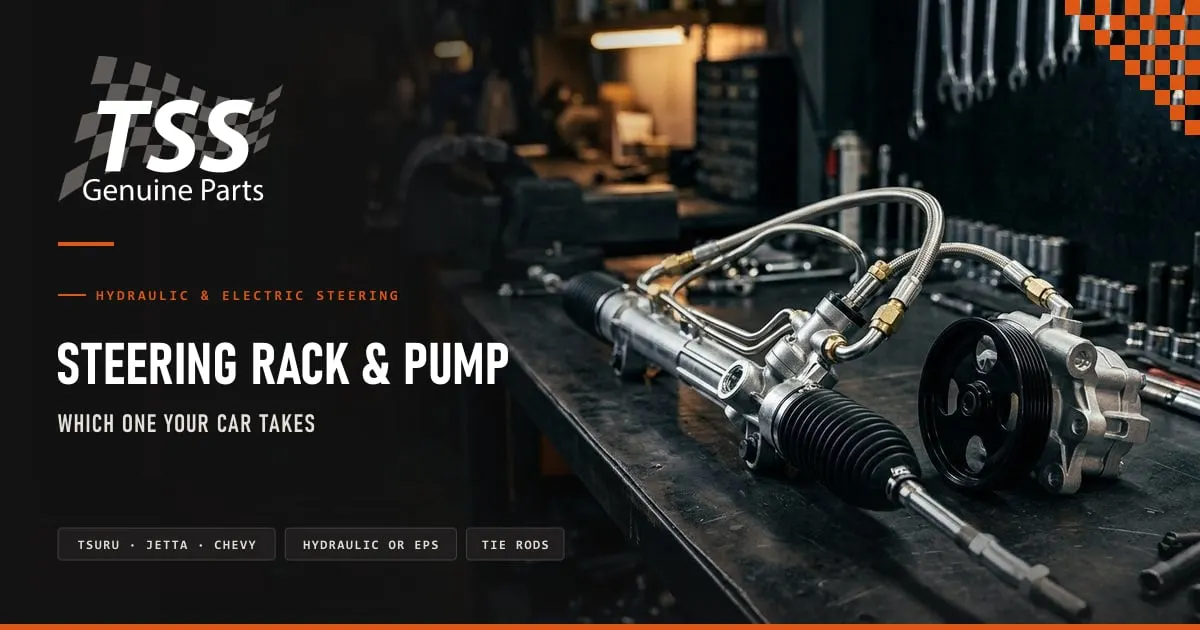
- If your car has a belt-driven pump with a reservoir and hoses running to the rack, its steering is hydraulic; with no pump and no hoses, it's electric.
- Check the trim: according to the carmakers, the base Tsuru GS I and GSI and base Chevys had manual steering, while the Sentra from 2007, the Accord from 2013 and the Vento have electric steering.
- “Con bieletas sin terminales” means the rack comes with the inner tie rods and you transfer or buy the outer tie rod ends; then the car needs an alignment.
- Before installing, the makers say to find out why the old part failed, flush the system and bleed the air; if the old fluid has metal in it, replace both the pump and the rack.
- The owner's manual decides the fluid: VW calls for hydraulic oil and no ATF, Honda for its own fluid, while Nissan, GM and Ford allow or call for ATF.
If you're replacing the steering rack or power steering pump on your car, first find out which system it has, because that decides which part fits. TSS carries steering racks and pumps for the most searched models in Mexico, such as the Nissan Tsuru, the VW Jetta, the Chevrolet Chevy, the NP300 and the Sentra. Here is how to tell whether your steering is hydraulic or electric, which TSS part fits each model according to the carmakers' parts catalogs, what the terms in the listings mean and what the carmakers ask for when you install one.
Does your car have hydraulic or electric power steering?
Open the hood and look for the pump. In hydraulic steering, the engine drives the pump with a belt: it has a pulley, a fluid reservoir, on the pump or separate, and two hoses, pressure and return, running to the rack. Electro-hydraulic steering also has hoses, but the pump is electric and has no pulley. Electric power steering (EPS) has no pump and no hoses: the electric motor sits on the steering column or on the rack, and the dash has a steering warning light that, according to Nissan's and Toyota's manuals for Mexico, comes on if the system fails.
Don't go by the manual's wording alone: Nissan's 2011 Altima manual for Mexico calls an engine-driven hydraulic system “electric assist”, and Ford Mexico's manuals call the Fiesta's electric system “electric hydraulic steering”. If in doubt, look at the pump or order the part with your car's VIN.
Check the trim too: several models were sold with manual steering, no pump and a different rack. According to the carmakers' spec sheets, that was the case on the Tsuru GS I and GSI, the base-package Chevys and the March Drive.
| Model (Mexico) | Steering |
|---|---|
| Tsuru III (1992–2017) | Manual on GS I and GSI; hydraulic on GS II, Special Edition and GSI 1.5 |
| Sentra B15 (2001–2006) | Hydraulic |
| Sentra from 2007, Tiida and Versa 2012–2019 | Electric |
| NP300 (2008–2015) and NP300 Frontier (from 2016) | Hydraulic; optional on the 2008–2015 NP300 Chasis |
| X-Trail | Hydraulic through 2007; electric from 2008 |
| Urvan (2002–2012) | Hydraulic |
| Jetta and Golf A2 and A3 (1987–1999) | Manual or hydraulic, depending on the version |
| Jetta A4 and Clásico (1999–2015), Golf A4 and New Beetle | Hydraulic |
| Jetta 2011–2019 (A6) | Hydraulic with the 2.0 or 2.5 engine; electric with the others |
| Pointer, Gol and Saveiro | Manual or hydraulic; never electro-hydraulic |
| Polo, Lupo, SportVan and CrossFox (through 2014) | Manual, hydraulic or electro-hydraulic, depending on the version |
| Vento (from 2014) | Electric |
| Chevy (1994–2012) | Manual on base packages; hydraulic on the others |
| Aveo (2008–2018) and Sonic | Hydraulic |
| Aveo from 2024 | Electric |
| Silverado and Cheyenne | Hydraulic through 2013; electric from 2014 |
| Accord | Hydraulic through 2012; electric from 2013 |
| Fiesta from 2011 and EcoSport from 2013 | Electric |
| Corolla from 2009 | Electric, with the motor on the column |
Which TSS rack fits your car?
These are the TSS racks for the most searched models. We checked the Nissan, Volkswagen and Toyota applications in parts catalogs; the rest come from TSS's product listing. Before you order, compare your part with the new one: length, mounts, hose fittings and pinion splines.
| Your car | TSS rack |
|---|---|
| Tsuru III with power steering (1992–2017) | Hydraulic, 49001-F4200 |
| Sentra B15 1.8 and 2.0 (2001–2006) | Hydraulic |
| Sentra B17 (2013–2019) | Mechanical, for electric steering |
| Tiida (2007–2018) | Mechanical, 48001-EM30B |
| NP300 Frontier (from 2016) | Hydraulic, 49001-4KH0A |
| Urvan (2002–2012) | Hydraulic, 49001-VW600 |
| X-Trail (2001–2007) | Hydraulic |
| Altima 2.5 (2002–2006) | Hydraulic, 49001-9J400 |
| Platina (2002–2010) | Hydraulic, 49001-00QAA |
| Jetta and Golf A2 with power steering (1987–1992) | Hydraulic, fine splines |
| Jetta and Golf A3 (1993–1999) and Derby | Hydraulic, coarse splines |
| Jetta A4 and Clásico (1999–2015), Golf A4 and New Beetle | Hydraulic, 1J1 422 062 D/E |
| Polo and Polo Sedán (2003–2012), Lupo (2004–2010) and SportVan (2006–2010) with a belt pump | Hydraulic, 5Z1 422 055, no sensor |
| Polo 2013 and 2014 with electro-hydraulic steering | 6R1 423 055 D, with sensor |
| Chevy with power steering (1994–2012) | Hydraulic, 94671442 |
| Corsa, Tornado and Meriva | Hydraulic, 93383067 |
| Sonic 1.6 (2012–2016) | Hydraulic, 95040656 |
| Trax with hydraulic steering (2013–2020) | Hydraulic, 95932780 |
| Fiesta 1.6 (2003–2010) and EcoSport (2004–2012) | Hydraulic |
| Focus 2.0 (2000–2011) | 3S41-3A500AB or 6M51-3A500AA, depending on the platform |
| Figo (2016–2022) | Mechanical, for electric steering |
| F-150 4x4 (2004–2008) | Hydraulic, 8L3Z-3504D |
| Japan-built Corolla 1.8 (2008–2013) | Mechanical, 45510-12450 |
| Yaris (2006–2012) | Mechanical, 45510-52140 |
| Hilux (from 2016) | Hydraulic |
| Kia Rio and Hyundai Accent (2018–2022) | Mechanical, for electric steering, 56500-H8200 |
| Hyundai Grand i10 (from 2015) | Mechanical, 56500-B4500 |
| Accord 2.3 (1998–2002) | Hydraulic, 53601-S84-G04 |
| Ram 700, Strada, Palio and Uno | Hydraulic, 51891679 |
Three notes. The Tsuru rack is for the power-steering versions, and TSS has none for the Tsuru II. Volkswagen used different racks by year, suspension and engine, according to VW Mexico's parts catalog, so compare your part number. And per Toyota's catalog, 45510-12450 is the rack for the Japan-built 1.8 Corolla, whose VIN starts with J; the 2014–2019 Corolla takes a different one.
And the pump?
Only hydraulic steering has a pump. The listings say “con o sin depósito” and “con o sin polea”, with or without reservoir and pulley: without reservoir means the reservoir is separate and reused; without pulley means you transfer yours. Pump makers' instructions say to remove the pulley with a puller, never hammering or pressing on the shaft, and to check that the new pump has the same pulley, mounting and fittings as the old one.
| Your car | TSS pump |
|---|---|
| Jetta and Golf A2 1.8 (1987–1992) | 027 145 157, no reservoir or pulley |
| Jetta A4 2.0 and 1.8T (1999–2008), Golf A4 and Beetle | 1J0 422 154 H, no reservoir or pulley |
| Aveo 1.6 (2007–2017) and Pontiac G3 | No reservoir, with pulley |
| Sonic 1.6 and Trax with hydraulic steering | 95040945, with pulley |
| Silverado 4.3, 4.8 and 5.3 (1999–2013) | 26081016, with reservoir |
| NP300 Frontier 2.5 gasoline (from 2016) | 49110-4JM0A |
| X-Trail 2.5 (2001–2007) | 49100-8H305, with pulley |
| Urvan 2.4 (2002–2006) | 49100-VW000, with reservoir and pulley |
| Altima 3.5 (2007–2012) | 49110-JA100 |
| Accord 2.4 (2008–2012) | No reservoir, with pulley |
| Platina, Aprio, Kangoo, Logan and Sandero | No reservoir |
| Ka, Fiesta and EcoSport (through 2012) | No reservoir, with pulley |
| Explorer and Ranger 4.0 | F77Z-3A674-EBRM |
| Equinox, Captiva and Traverse with hydraulic steering | 20954812 |
| Sprinter 2.2 and 2.7 | With reservoir and pulley |
If your car's pump has a pressure sensor or switch, move it to the new one: a pump maker warns that if it isn't transferred correctly, the shaft seal fails from excessive pressure.
What “con bieletas sin terminales” means
Most TSS racks say “con bieletas sin terminales”: with inner tie rods, without outer tie rod ends. The inner tie rods (bieletas) are axial ball joints that thread onto the ends of the rack; the outer tie rod ends (terminales) connect the inner tie rod to the steering knuckle. The rack arrives with the inner tie rods installed, and you transfer the outer ends from the old rack or buy new ones.
- Reuse the outer ends only if they're in good shape: Nissan measures their play and the force needed to move them, and replaces them if they're out of spec.
- Align the car afterwards: Nissan says to do the final tightening with the car on the ground and unloaded, and then check the wheel alignment.
- When setting the toe, loosen the boot clamps so the boots don't twist, as one rack maker instructs.
Other terms in the listings:
- Mecánica asistida or electroasistida: the rack for cars with column-mounted electric steering. It has no valve and no fluid; the motor, control unit and torque sensor are on the column.
- Estriado grueso or delgado (spelled “astriado” in the listings): coarse or fine pinion splines, where the column's intermediate shaft fits. According to VW Mexico's catalog, the Jetta A2 and A3 racks are different.
- Con, para or sin sensor on Volkswagens: according to VW Mexico's catalog, electro-hydraulic steering has an angle sensor mounted on the rack and the belt-pump version doesn't. We read “con sensor” as sensor included, “para sensor” as reusing yours and “sin sensor” as the belt-pump rack; confirm with your part.
- Tipo Koyo or TRW: the maker of the original rack. In electro-hydraulic systems, VW uses different pumps and sensors for each, so don't mix them.
- Con or sin depósito, con or sin polea: whether the pump comes with the reservoir and the pulley; anything it doesn't include comes off the old pump.
Is it the rack or the pump?
Many steering problems aren't the rack. Before replacing it, here is what the carmakers' manuals and bulletins say (some are US documents):
| Symptom | Check first |
|---|---|
| Hard to turn both ways | Fluid level, air in the system, a loose belt and pump pressure; with electric steering, a lot of turning while stopped reduces the assist to keep it from overheating |
| Hard to turn one way | Collapsed hoses or debris in the system; rarely, an internal leak in the rack |
| Whine or clicking when turning | Air in the system or a fluid problem; with electric steering, a slight motor hum is normal, per Toyota |
| Clunk or play in the wheel | Inner tie rods, tie rod ends, the column's intermediate shaft and the suspension |
| Fluid on the boots | Squeeze the boot: if no fluid comes out, Nissan says not to replace the rack; GM doesn't replace it for less than a tablespoon |
| Wheel doesn't return or sits off center | Tires and alignment first, per Nissan; then the suspension |
| Steering warning light on | On electric steering: the column, control unit, sensor and wiring, not the mechanical rack |
For more on each problem, Sun Transmissions has articles on how power steering works, hard steering, power steering fluid leaks and rack and pinion steering.
Before you install: what the carmakers ask for
- Find out why the old part failed: according to a pump maker, a new pump doesn't fix the rest of the system, and whatever isn't repaired can damage it.
- Flush the system and don't reuse the fluid you drained, as Nissan says. Look at the old fluid: if it has metal particles in it, a rack maker says to replace both the pump and the rack.
- Check the hoses: they wear from the inside and it doesn't always show outside. Replace any that are hard or porous, and fit new O-rings at the connections.
- With the rack out, keep the steering wheel locked straight ahead: Nissan warns that if it turns, the airbag's spiral cable can be cut.
- Torque the intermediate shaft bolt to the carmaker's spec: there were US recalls because that bolt could come loose or break, on the 2021 and 2022 Kia Rio and Hyundai Accent and on the 2005 Silverado.
- Bleed the air. Nissan says to raise the front wheels, fill the reservoir and turn the wheel lock to lock with the engine off until the level stops dropping, then repeat with the engine running. Bubbles, clicking or a buzz at the pump mean there's still air.
- Check the belt tension: Nissan does it before testing the pump and after installing one.
- Align the car when you're done and, if your car needs it, calibrate the steering angle sensor.
- Don't hold the wheel against the stop: Nissan says no more than 10 to 15 seconds; GM, no more than 5 seconds above 1,500 rpm; and the Trax manual for Mexico warns of damage after 15 seconds.
What fluid does it take?
Whatever your owner's manual says. Volkswagen calls for G 002 000 hydraulic oil and says not to use ATF; Honda calls for its own power steering fluid; Nissan Mexico for PSF or Dexron VI ATF, and Dexron-type ATF in the Tsuru; GM Mexico for Dexron VI; and Ford, in the 2002 Ranger, for Mercon ATF. So neither “any fluid works” nor “never use ATF” holds. Electric steering takes no fluid.
Are there recalls?
We found no PROFECO (Mexico) recalls for the racks, pumps or hoses of the models TSS covers; the steering recalls there are for other generations or models, such as the 2013–2019 Urvan or the 2021 Versa and Kicks. In the US there were recalls for some of their twins, for example for hoses on the 2005 and 2006 Silverado and the 2015 Compass and Patriot. You can check your VIN at NHTSA.
See TSS steering racks and pumps
TSS steering racks and pumps
The TSS catalog has about 60 steering racks and pumps: hydraulic racks with inner tie rods, such as the Tsuru, Jetta, Chevy and NP300 ones; mechanical racks for the electric steering of the Sentra, Tiida, Yaris, Rio and Grand i10; and pumps with or without reservoir and pulley. There are also belts for electric steering racks on GM trucks.
In Mexico, Transmisiones Veinte 07 sells them online in its steering rack and power steering pump collections.
TSS is an aftermarket brand with OEM-comparable quality and quality control on every product. You can buy it from our authorized distributors: in the United States from Sun Transmissions, and in Mexico the full TSS catalog at Transmisiones Veinte 07.
 Cremallera Direccion Hidraulica Con Bieletas sin Terminales Tsuru III 1.6L 1992/17 49001-F4200
 Cremallera Direccion Hidraulica Jetta A4 Golf A4 Beetle Leon Toledo 1J1-422-062D/E
 Bomba Direccion 1J0-422-154H Jetta A4 Clasico 99/15, Golf A4 99/07, Bettle 98/05, Passat 92/07
 Cremallera Direccion Hidraulica Con Bieletas sin Terminales 94671442 Chevy C2 C3 1.4L 1.6L 1994/12
 Cremallera Direccion Hidraulica 49001-4KH0A NP300 Frontier (D-23) 2016/22
 Cremallera de Direccion Hidraulica C/Bieletas Sin Terminales Sentra 1.8 2.0 2.5 L Almera 2001/06
 Cremallera Direccion Hidraulica Astriado Grueso C/Biel S/Ter (Jetta Golf 1993/98) (Derby 1995/09)
 Bomba de Direccion Hidraulica Sin Deposito Con Polea ( G3 2006/09 ) Aveo 1.6 L 2007/17