
- Before blaming the transmission, check the fluid level the way your maker says and make sure the dash shows the same position as the lever: a loose or misadjusted shift cable also stops reverse.
- On many transmissions reverse shares parts with other gears: if 3rd and 5th are also gone (6T40), or 2nd and 4th (4L60E), or only 1st and R remain (6F35), that points to the part.
- It isn't always a fault: many transmissions block reverse while the car is still rolling, and on the 09G, releasing the brake before the gear engages leaves it in neutral.
- In limp mode most automatics keep P, R and N; dual-clutch ones like the PowerShift and DSG can lose reverse.
- If the lever won't leave P, press the brake firmly; if it still won't move, it can be the battery, a fuse or the brake lights, and the owner's manual explains the manual release.
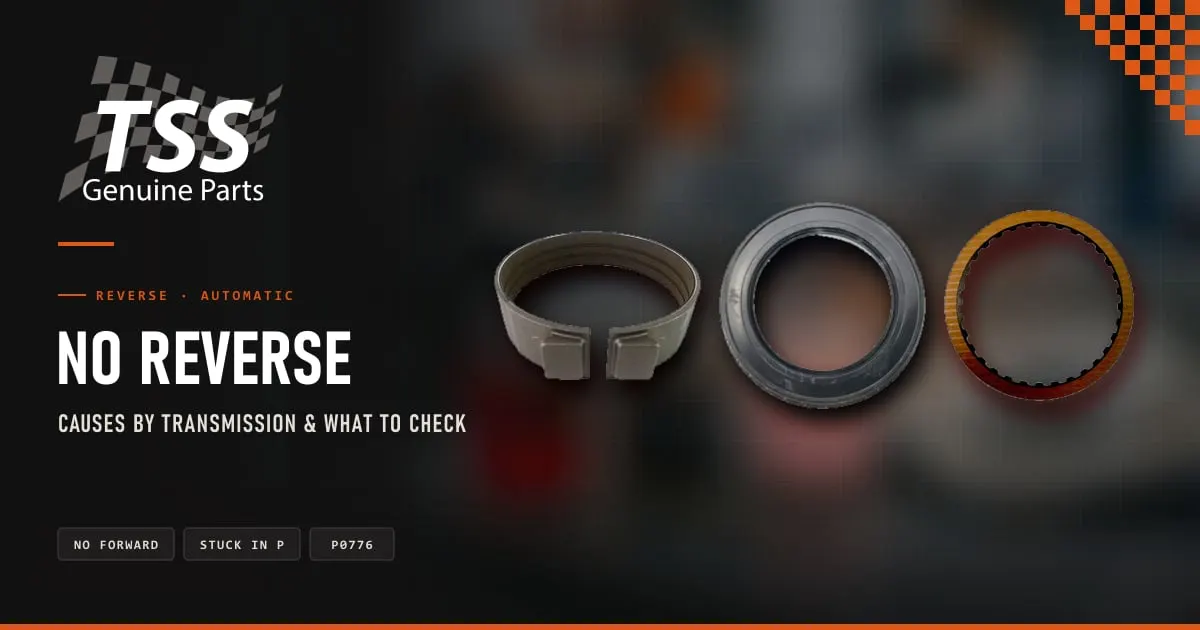
If your automatic won't go into reverse, is slow to engage or engages with a bang, the cause can be outside the transmission (the shift cable, the range sensor, the fluid level) or inside it (a clutch, a band or the valve body). Here's what to check first, which other gears fail together with reverse on each transmission, and how to release the lever if it won't leave P. This guide is for automatics: on a manual car, reverse is diagnosed differently.
First: what to check before opening the transmission
- The fluid level, checked the way your maker says: Toyota asks to confirm it before ordering parts or reprogramming, and Nissan's and Ford's reverse diagnostics start there. Each transmission is checked differently (dipstick, fill plug or scan tool), and each of our guides explains how.
- That the dash shows the same position as the lever: if they don't match, suspect the shift cable or the range sensor. In Mexico, Ford recalled 8,332 Escape and Fusion and 3,765 Fusion because the shift cable bushing could come off.
- The range sensor: Ford documented on the 2011 and 2012 F-150 in the US that, out of calibration, it could keep reverse from engaging and leave the reverse lights off.
- Bangs that aren't the transmission: Ford and Chrysler include engine mounts, the driveshaft and the U-joints in their diagnosis of a harsh reverse engagement.
Which other gears fail together with reverse?
Reverse rarely works alone: it shares clutches or bands with other gears. So knowing what else fails helps find the part:
| Transmission and symptom | Which part it points to |
|---|---|
| 6T40 in the Cruze, Trax and Equinox: no reverse, 3rd or 5th (P0776) | The 3-5-R clutch piston and plate. GM says to inspect them before replacing the transmission module (TEHCM). |
| PowerShift in the Focus, Fiesta and EcoSport: no reverse, but 1st, 3rd and 5th work | The clutch B side: its actuator motor, the drum, the 4th/reverse fork or the synchro (P073E, P07A4, P2837). |
| DSG: only the even or only the odd gears work | The mechatronic unit shut off the failing half of the transmission; depending on the model, reverse sits on one half or the other. |
| 4L60E in the Silverado and Cheyenne: no reverse, 2nd or 4th, but 1st and 3rd work | A stripped sun shell. If only reverse is missing: the reverse input clutch, the low/reverse clutch or the valve body. |
| 6F35 in the Escape and Fusion: only 1st and reverse, no upshifts (P07A9) | The low one-way clutch or the low/reverse clutch; Ford notes it isn't a solenoid. |
| 6R80 in the F-150 and Expedition: reverse is late or won't engage, and no engine braking in 1st (P07A8) | Clutch D, low/reverse. If it slips in reverse, 3rd and 5th: clutch B. |
| 46RE and A518 in the Ram and Durango: no reverse and no engine braking in 2 | The overdrive direct clutch. Slipping in 3rd and reverse: the front clutch. Only reverse missing: the rear band, out of adjustment or worn. |
| 41TE and 62TE in the Voyager, Town & Country and Journey: won't move or slips in reverse and 1st | The low/reverse clutch circuit; Chrysler documented an accumulator O-ring that could come out of place. |
| Versa, March and Tsuru (RE4F03 and JF414E): no movement in R | The engine-braking test in 1 tells them apart: no engine braking points to the low & reverse brake; engine braking OK points to the reverse clutch. |
| 4R70W in the F-150 1997 to 2003 and Grand Marquis: reverse won't engage or slips | The reverse drum (its diaphragm spring and piston seals), the low/reverse band and its servo. |
| 5R55E and 5R55W in the Explorer and Ranger: late reverse or a burnt band | The reverse servo, wear in its bore in the case, and the reverse band. |
| DP0 and AL4 in the Platina, Clio and 206: slips in reverse | Clutch E1 and band F2; over time the E1 seals harden and lose pressure. |
| 01M in the Jetta A4: no reverse | Clutch K2 or brake B1, as the aftermarket names them. |
Note: the 41TE, 62TE, 6R80 and 6T40 have no reverse band, only clutches; on those, "it's the band" doesn't apply.
Why does reverse sometimes not engage?
First, bring the car to a full stop. The Mexican owner's manuals for the Versa, Aveo and Fiesta say to select reverse only when the car is stopped, and many transmissions block reverse if the computer sees the car still rolling; on the Aveo, ATSG puts it at about 5 mph (8 km/h). On the 09G, Volkswagen explains that if you release the brake before the gear engages, the transmission stays in neutral and the letter on the dash flashes, without any fault.
If it happens often with the car stopped, check the cable and the range sensor, and ask the dealer about updates: Ford fixed an intermittent loss of reverse on the 2015 to 2017 F-150 in the US with a reflash, when shifting from manual to reverse while rolling slowly. And if reverse stopped working right after a repair, Sonnax documents a common mistake: swapped speed sensors, which make the computer think the car is rolling.
Why is reverse slow to engage in the morning?
Several makers document delays or bangs into reverse on the first start of the day, in US bulletins: Ford, on the 6R80 in the 2011 to 2014 F-150 and Expedition, from the pump; Honda, on the 2013 and 2014 Accord, because fluid drains out of the converter while parked (and on the 2015 and 2016 CR-V the engine could stall when shifting into reverse cold); and GM, on the 4T65E, with cold fluid. Others are fixed with software, as on the 6F35 in the 2016 Escape and Fusion.
If it's always slow, not just when cold, check the level, the filter and the valve body.
Why does it go in reverse but not forward?
It's the opposite case: the forward side is failing. After checking the level, GM links it on the 4L60E to the forward sprag or forward clutch; on the 6T40 it points to the 1-2-3-4 clutch or its solenoid (P2723); Chrysler, on the A518, to the rear clutch, which works in every forward gear; and on the 01M the K1 clutch is checked. The PowerShift is different: if clutch 1 fails, the car keeps reverse and pulls away weakly in 2nd.
Limp mode: will I still have reverse?
On most automatics with a torque converter, yes: Chrysler, Ford (6R80) and Volkswagen (09G) document that in limp mode P, R and N keep working, and the transmission holds a single forward gear. Dual-clutch transmissions are the exception: on the PowerShift, if the side that carries reverse fails, you get 1st, 3rd and 5th with no reverse, and Volkswagen warns in its Mexican manuals that reverse sometimes can't be used.
The lever won't come out of P: how to release it
To leave P you need to press the brake firmly with the ignition on and, on many cars, press the lever button. If it still won't move, the Mexican manuals name three causes: a low battery (on the Trax, below 9 volts the lock won't release), a fuse or the brake lights (Ford, 2016 F-150), or parking on a slope without the parking brake, so the car's weight loads the parking pawl (Trax).
The Versa, Aveo, Trax and F-150 manuals explain the manual shift-lock release: with the parking brake set, remove a small cover next to the lever and press the release (on the Aveo, with the key) to move to N. Use it only to move the car and get it checked; Ford says not to drive until you've verified the brake lights work. Don't force the lever or bypass switches.
What won't fix reverse
- An additive: Ford Mexico says not to use additives or cleaners in transmission fluid because they can damage it, and no maker documents an additive that fixes reverse.
- Bypassing the neutral switch or range sensor: it lets the engine start in gear, which is dangerous; in the US there have been recalls over that failure.
- Replacing the transmission module first: on the 6T40, GM says to inspect the 3-5-R piston before replacing the TEHCM.
- Disconnecting the battery: it doesn't repair worn parts, and on some cars it erases what the transmission learned.
- Shifting into reverse while rolling: the Versa, Aveo and Fiesta manuals warn it damages the transmission.
Which TSS part do you need?
These are the TSS reverse parts for each transmission. Always compare the new part with yours, because several transmissions have versions by year:
| Transmission | TSS reverse parts |
|---|---|
| 4L60E | reverse input frictions and low/reverse frictions |
| 41TE, 42RLE and 62TE | low/reverse frictions; for the 41TE and 42RLE, low/reverse diaphragm |
| 46RE and A518 | solid reverse band, 6.25" drum |
| 4R70W | reverse band, reverse drum diaphragm and reverse servo piston |
| 4T65E | reverse band, 1991 to 2000 only |
| 01M | K2 reverse piston, B1 low/reverse piston and B1 frictions |
| 5R55E | low/reverse sprag |
| 6T40, 1st generation | friction pack |
| PowerShift | actuator motor and range sensor |
| DP0 and AL4 | F2 servo piston and range switch |
| RL4F03A and RE4F03A (Tsuru) | low/reverse friction pack |
| Range sensor, if the reverse lights don't work either | Aveo, 4L60E 2004 on, A604, 4F27E and Nissan JF011E CVT |
 Banda Nueva Reversa Solida (Aplica a Tambor 6.25in Ancho) A518 A727 T8 37RH 36RH 46RE 46RH
 Banda Reversa Nueva AOD AODE 4R70W 4R75W
 PISTON VULCANIZADO REVERSA (K2) VW095, VW096, VW097, VW098, 01M, 01N, 01P
 Disco de Pasta TSS Baja y Reversa (B1) .063 [4-5] 50D AG4 01M VW095 095-323-231C
 Disco de Pasta TSS Entrada Reversa .070 [4] 4L60E TH700 TH700-R4 4L65E 4L70E
 Disco de Pasta TSS Baja y Reversa .072 [5-6] 32 Dientes A604 A606 42RLE 62TE
 Motor Actuador para Caja Doble Clutch Powershift 6DCT250 DPS6
 Banda Reversa (Delantera) 1991/2000 4T60E 4T65E