
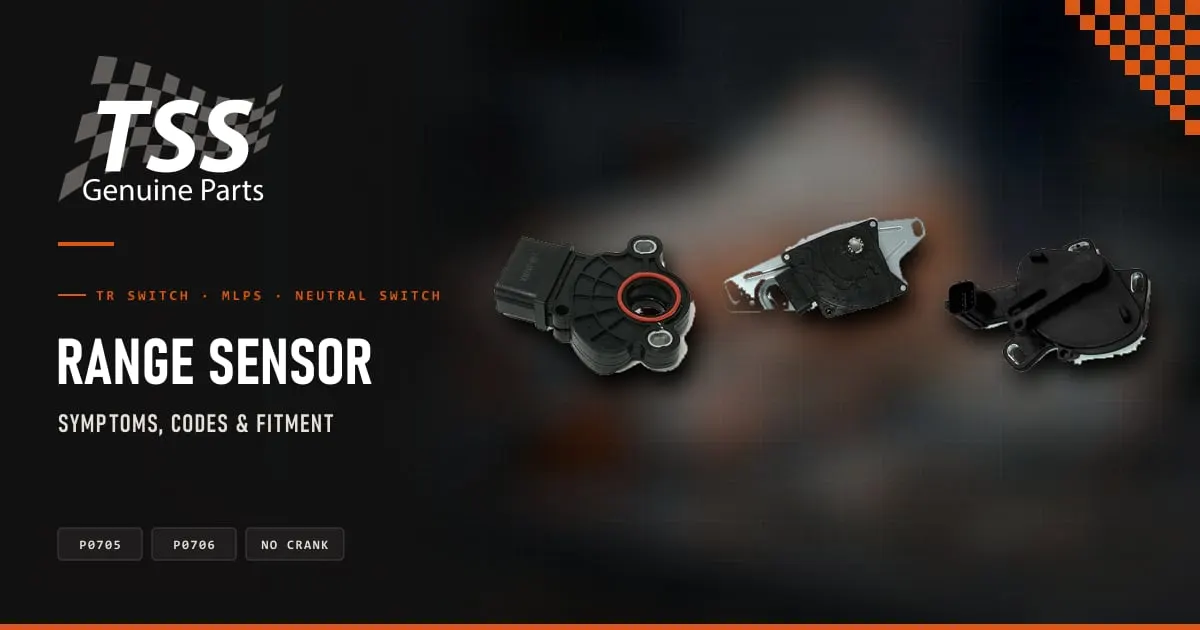
- The range sensor, also called TR switch, MLPS or neutral safety switch, tells the car where the shifter is: it only lets the engine crank in P and N, turns on the reverse lights and shows the position on the dash.
- Typical symptoms are no crank in P or N, no reverse lights, the dash showing another position, and odd shifts or limp mode.
- P0705 to P0709 mean a fault in its circuit, not that it must be replaced: carmakers check cable adjustment, the connector, fuses, grounds and the battery first.
- A new sensor is adjusted with the transmission lever in N and an alignment pin, and on some transmissions, like the PowerShift, it needs a learn with a scan tool.
- If the engine cranks in D or R, it's a safety fault: don't drive it like that.
If your car won't crank in P but will in N, the reverse lights don't come on or the scan tool shows P0705 or P0706, the problem is most likely the transmission range sensor, or its circuit. Here's what it is, where it is, its symptoms, what each code means, what carmakers check before replacing it, how a new one is adjusted and which one your car takes, according to Nissan, Ford, GM, Hyundai, Kia, Mazda and Isuzu bulletins and manuals.
What is the transmission range sensor and what does it do?
It's the part that tells the car where the shift lever is. It goes by many names: range sensor, TR switch, MLPS (Ford's manual lever position sensor), neutral safety switch, inhibitor switch (Hyundai, Kia and Mitsubishi), multifunction switch (Volkswagen, Renault and Peugeot) or IMS when it's inside the transmission (GM). On almost every automatic it does four jobs:
- It only lets the engine crank in P or N.
- It turns on the reverse lights when you select R.
- It sends the position to the dash (P, R, N, D).
- It tells the transmission computer where the lever is, so it knows what to do.
On newer cars, other systems use its signal too: the backup camera, the shift lock that keeps the lever in P until you press the brake, push-button start and the electric parking brake, among others.
Where is the range sensor?
On most automatics it's outside the transmission, bolted to the shaft where the shift cable lever attaches, and it can be adjusted. That's the case, for example, on the JF011E CVT in the Sentra and Compass, the Focus's 4F27E, the PowerShift, the 4T65E and Renault and Peugeot's DP0. On the 41TE from 1996 it bolts on from outside, but its tip goes into the case through a hole. On others it's inside: GM's 4L60E from 2009, the 6L80 and the 6T70; Ford's 6R80 (in the Lobo / F-150), where it's part of the internal harness; and Ram's 45RFE and 545RFE, on top of the valve body. Older rear-drive Chryslers like the 46RE use a threaded neutral switch. We cover them in 6R80 problems and 45RFE and 545RFE problems.
Symptoms of a bad range sensor
- It won't crank in P but will in N (or the other way around), or sometimes it won't crank.
- The reverse lights don't come on, or the backup camera image doesn't appear.
- The dash shows another position, goes blank or the letter flashes.
- Harsh or odd shifts, stuck in one gear or in limp mode.
- The check engine light may come on with a code from P0705 to P0709.
- It cranks in D or R: that's a safety fault, because the car can move when it starts. Don't drive it like that until it's fixed.
Watch for look-alikes: a no-crank can also be the battery or starter; on push-button cars, the brake pedal switch (in 2021 PROFECO, Mexico's consumer agency, issued an alert for 2017 to 2019 Sentras whose brake switch could keep the engine from starting); or a misadjusted shift cable. And reverse lights that don't come on can be a bulb, a fuse or the wiring. If the problem is that it won't shift, see transmission not shifting.
Codes P0705, P0706, P0707, P0708 and P0709
| Code | What it means and what to check |
|---|---|
| P0705 | Transmission range sensor "A" circuit fault (PRNDL input). Check the sensor reading on the scan tool against the lever, the cable adjustment, the connector (bent or wet pins), fuses and grounds, and aftermarket alarms or remote starters. |
| P0706 | The range sensor signal doesn't make sense to the computer (range/performance). Check the cable and switch adjustment first, then the connector, and the switch last. |
| P0707 | Low signal in the range sensor circuit. Check the power feed and fuses, a stretched or misadjusted cable and chafed wiring. |
| P0708 | High signal in the circuit, or two positions at once. GM says to check the battery first, because low voltage can set it. |
| P0709 | Intermittent circuit fault. Check loose connections, pushed-out pins and the harness; on some Fords the fix is a software update. |
Some brands use their own codes: GM, on transmissions with the sensor inside (IMS), uses P182E, P1825 and P1915, which can also leave the dash blank and the car without cranking; Honda uses P1705 and P1706; Ford adds P1702 to its range sensor codes; and Volkswagen shows them as 17089 and 17090, equivalent to P0705 and P0706.
Before replacing the range sensor: what carmakers check
A P0705 to P0709 code means a circuit fault, not that the sensor must be replaced. Isuzu, for example, found many switches replaced for P0707 with no fault found, and the cause was an open fuse or a stretched or misadjusted cable. In the US, on the 2012 to 2014 Versa sedan with a CVT, Nissan found P0705 came from water in the tail lamps, and said explicitly not to replace the CVT. The order Hyundai, Kia, GM and Isuzu follow is:
- Read on the scan tool the position the computer sees (P, R, N, D) and compare it with the lever.
- Check the shift cable and switch adjustment.
- Check the connector: bent or spread pins, seals and moisture.
- Check fuses and grounds: Hyundai and Kia check the rear combination lamp ground.
- Rule out aftermarket alarms or remote starters, and low battery voltage.
- Only then, replace the sensor.
The same goes for the transmission's other sensors: the connector and wiring usually fail first. More in TSS transmission sensor and transmission solenoids.
How a new range sensor is adjusted
A new sensor isn't just bolted on. Nissan says the range switch on its CVTs "must be adjusted after its replacement": with the transmission lever in N, a tool pin goes into the switch's hole and the bolts are tightened, and the lock washer is one-time use. Hyundai and Kia adjust it in N with a guide pin or a 5 mm bolt; Mazda warns that improper adjustment causes abnormal transmission operation; and Toyota says not to move the transmission lever with the switch removed, because the detent spring can come loose. On Ford's PowerShift, after replacing it you run the range sensor learn with a scan tool, then the shift drum learn and then the clutch learn; see PowerShift problems.
When done, check:
- That it cranks only in P and N: try every position with the brake pressed.
- That the reverse lights, and the camera if fitted, come on only in R.
- That the dash shows the same position as the lever in every position.
- That the lever won't leave P without pressing the brake.
- Clear the codes and drive: Hyundai calls for two drive cycles.
And never bypass it to make the car start: that lets the engine crank with the lever in D or R.
Recalls over the range sensor
In the US, Ford recalled nearly 1.4 million 2015 to 2017 F-150s with the 6R80 in April 2026, because the range sensor signal can drop out and the transmission can suddenly downshift to 2nd or shift to neutral; the fix is a software update and, if codes P0705, P0706, P0707 or P1702 were already stored, a new internal harness. In 2012, Ford also recalled 2011 to 2013 F-150, Expedition, Navigator and Mustang models that could lose reverse and the reverse lights. In Mexico we found no PROFECO alert over the range sensor (we checked on October 27, 2026); see 6R80 problems.
Which TSS range sensor does your car take?
These are the TSS range sensors and switches and the cars they fit, per our guides to each transmission. On several transmissions the connector or design changed by year, so always compare the connector and part number with yours before ordering:
| Vehicle | TSS sensor or switch |
|---|---|
| Nissan Sentra 2007 to 2012, X-Trail 2008 to 2014 and Altima 2.5 2007 to 2012 (JF011E CVT) | TR switch with 90° connector |
| Jeep Compass 2007 to 2013, Patriot 2008 to 2013, Dodge Caliber 2007 to 2012, and Mitsubishi Lancer and Outlander with CVT through 2015 and ASX 2013 and 2014 (JF011E) | TR switch with straight connector |
| Ford Focus 2012 to 2018, Fiesta 2011 to 2019 and EcoSport 2013 to 2017 (PowerShift) | DPS6 range sensor; after installing it, Ford requires its adaptive learning with a scan tool |
| Ford Focus 2000 to 2011, EcoSport 2.0 automatic through 2012 and Mazda3 2.0 through 2009 (4F27E) | 9-pin TR switch; not the one for the FNR5 5-speed |
| Ford Escape 2001 to 2008 (CD4E) | CD4E TR switch |
| Ford Windstar, Taurus and Mercury Sable 1993 to 1997 (AX4S and AX4N) | 8-pin TR switch |
| Ford F-250 and F-350 with the E4OD, 1989 to 1996 (per TSS) | E4OD TR switch |
| Chevrolet Aveo 2008 to 2018 (AW81-40LE) | TR switch 93741830; TSS's title names another transmission: confirm it by part number |
| Chevrolet Silverado, Cheyenne and others with the 4L60E | through 2003, 77947; 2004 to 2008, 77947A; from 2009 it's inside the transmission: 77947B |
| Chevrolet Venture, Uplander, Impala, Grand Prix and Aztek (4T65E) | switch through 2003 or from 1999: compare the connector |
| Chrysler Voyager, Town & Country, PT Cruiser, Cirrus and Stratus, and Dodge Journey, Avenger and Chrysler 200 2.4 (41TE) | 1995 to 1998, round pins: 92928; from 1998, flat pins: 92928A; before 1996, external neutral switch: 92927 |
| Ram 1997 to 2001, Durango 5.9 through 2003 and Grand Cherokee 4.0 (46RE and A518) | threaded neutral switch; confirm yours is the threaded type |
| Renault Duster, Clio, Megane, Logan, Sandero, Captur and Oroch; Peugeot 206, 207, 307, 208 and 2008; Nissan Platina (DP0 and AL4) | DP0 / AL4 multifunction switch |
| Chevrolet Silverado and GMC Sierra 2500 and 3500 with the Allison 1000 (from 2006, per TSS) | Allison TR switch |
On the Lobo / F-150 with the 6R80, Rams with the 45RFE or 545RFE and Silverados with the 6L80, the sensor is inside the transmission (on the internal harness or the valve body) and isn't in this list.
TSS sensors and switches
TSS has range sensors, neutral switches, speed sensors and solenoids for most automatic transmissions in Mexico. Confirm the model, year and transmission before ordering.
TSS is an aftermarket brand with OEM-comparable quality and quality control on every product. It's sold through our authorized distributors: in Mexico, the full TSS catalog is at Transmisiones Veinte 07, and in the United States at Sun Transmissions.
 Switch TR MLPS Conector 90° Nissan JF011E RE0F10A
 Switch Parking Neutral Conector Recto Dodge Jeep Mitsubishi JF011E RE0F10A
 Sensor Switch Rango TRS 6DCT250 DPS6
 Switch TR 9 Pines Ford Mazda Transmision Automatica 4F27E OEM 5S4Z-7F293-AA
 Switch Tr Posicion De Palanca U441E U440E
 Switch TR DPO AL4 OEM 252410 Renault Peugeot
 Switch Tr Posicion De Palanca 2004/up 4L60E 4L80E
 Switch Tr Posicion De Palanca Mlps Pines Planos 1998/UP A604