
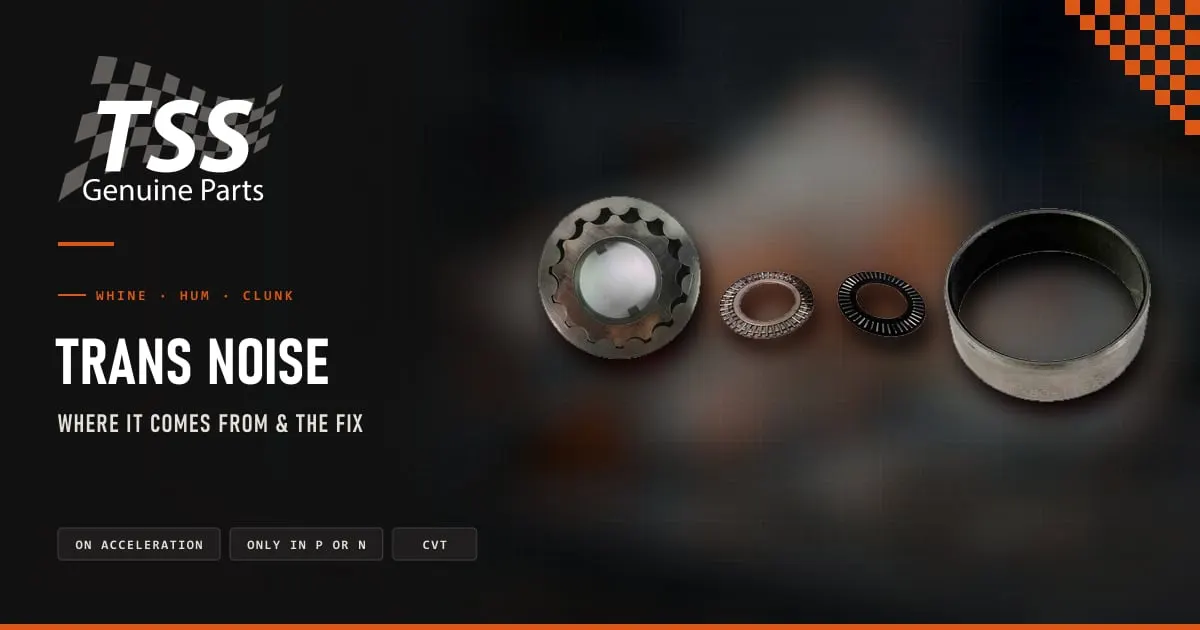
- Before blaming the transmission, rule out wheel bearings, tires, half-shafts, mounts and exhaust heat shields: Nissan, Mazda and Honda have bulletins because they get mistaken for it.
- The key clue is whether the noise follows rpm (pump, converter) or road speed (bearings, gears, differential, tires).
- A whine only when stopped in D or R that goes away once moving is usually the converter, per GM; one heard in every position that rises with rpm, the pump.
- A CVT can whine a little and it's normal, per Nissan; it isn't if it's louder than an identical car or rises with road speed.
- Low fluid causes pump noise, and Ford says not to drive that way: if fluid is missing, there's a leak.
A whine on acceleration, a howl that rises with speed or a clunk into D doesn't always come from the transmission, and makers have bulletins so shops don't replace a transmission for a wheel bearing or a tire. Here's how to tell where the noise comes from, when a CVT whine is normal, which noises each transmission has documented and which TSS part fixes it.
First: is the noise coming from the transmission?
Before opening the transmission, Nissan and Mazda ask to compare it with an identical car (same trim and tires) and to road-test it, not just listen on the lift, and GM warns that a noise noticed while moving may not come from the transmission. These are the parts most often mistaken for it:
- Wheel bearings: Nissan describes their noise as a warbling whine that rises with speed, and Honda explains it doesn't change when you shift to neutral or accelerate, while a transmission bearing's noise changes with load.
- Tires: Mazda asks to check size, brand and wear, and to swap the wheels with those of a quiet car.
- Half-shafts and CV joints: clicks when pulling away or accelerating.
- Engine and transmission mounts, and on trucks the driveshaft: clunks shifting into D or R.
- Engine accessories (belt, alternator, A/C, power-steering pump): Nissan says to remove the belt to rule them out.
- Exhaust heat shields: a rattle that rises with rpm but not with road speed.
Does it follow road speed or rpm?
That's the question makers ask. Ford uses two road tests, which you should only do where it's safe:
- Shift to neutral above the speed where the noise appears and coast down: if the noise remains, it's speed-related, and Ford rules out the engine and the converter.
- Hold the same rpm in a lower gear: if the noise repeats, it's engine-speed related, and Ford rules out tires, wheels, brakes and suspension.
That separates almost everything: a noise that follows rpm points to the pump or converter; one that follows road speed, to bearings, gears or the differential inside the transmission, or outside it, to tires and wheel bearings.
What noise does each part make?
| When you hear it | What it usually is |
|---|---|
| A whine that rises with rpm in every position, including P and N | The pump: GM explains that its noise changes with line pressure. A clogged filter, a filter seal sucking air or low fluid sound the same. |
| Louder in reverse | Also the pump: line pressure rises in reverse. |
| A whine only when stopped in D or R, rising with throttle and gone once moving or when the converter locks up | The converter bearings, according to GM, which says not to replace the converter if the noise is heard in P or N. |
| A whine or howl that rises with road speed and changes with load | Planetary gears, bearings or the differential inside the transmission; on a CVT, the pulley bearings. |
| A whine in one gear only | A planetary set: if the noise goes away in direct drive (1:1), it points to the gears; only in 1st points to the front planetary, and starting in 2nd, to the rear one. |
| A rattle at start-up or idle | A cracked flexplate or loose converter bolts, as Ford documented on the 6F35 and VW on the 09G. |
| A clunk shifting into D or R | Mounts, U-joints or driveline lash, or a harsh engagement from pressure or clutches. On the 4L60E, GM considers the 2-3 and 3-2 shift clunk normal. |
| Noise at the shifter or in the cabin at highway speed | Sometimes the transmission is fine and the shift cable carries the noise into the cabin: VW, Toyota and GM changed brackets or cables on the Jetta, Camry and Equinox. |
Transmission noise when accelerating
If the noise comes on when accelerating and changes with load, Honda explains it points to a transmission bearing or gear rather than a wheel bearing, which sounds the same in neutral or off the throttle. On a CVT, Sonnax explains that bearing failures are common: fluid and pressures are fine, but a whine is heard on acceleration; and Honda documents that a CVT low on fluid makes pump noise when accelerating. On the 6R80, Ford documented a whine on acceleration that stops when the converter locks up, and fixed it with a new converter and pump seal.
Is it normal for a CVT to whine?
A little, yes. In its US bulletins, Nissan considers normal a slight whine in the CVT's single shift between about 20 and 50 mph (Sentra 2013 to 2019, Note, Kicks and Versa 2020 on), when braking to a stop below about 10 mph, and from the oil pumps at idle or on acceleration. It also says not to judge it on a lift: without load, a CVT sounds louder.
It isn't normal if it's much louder than an identical car, if the whine rises with road speed (bearings, per Nissan and Mitsubishi), or if it appears in P or N and stops when shifting to D with the car stopped: on the 2013 to 2017 Sentra CVT, Nissan's flowchart calls for replacing the CVT, and another bulletin ties it to the input shaft bearing. More failures in the Nissan CVT guide.
Noise from low fluid
Low fluid makes noise: Honda says a CVT low on fluid makes pump noise when accelerating, GM speaks of a pump whine, Ford of pump cavitation, and Chrysler lists low fluid as the first cause of a buzz. Ford warns not to drive with a low level because it can cause internal failure, and if fluid is missing, there's a leak to fix. Overfilling doesn't help either: according to Ford, the fluid foams. A clogged or poorly seated filter sounds the same as a low level.
Documented noises by transmission
These are the noises makers documented on the transmissions that sell most in Mexico, almost all in US bulletins:
| Transmission | Documented noise and cause |
|---|---|
| Nissan CVT JF015E (Sentra 2013 to 2019, Note) | A slight whine in its single shift is normal; a noise in P or N that stops in D with the car stopped is tied to the input shaft bearing. |
| Nissan CVT JF016E (Altima 2.5 2013 to 2018, X-Trail 2015 to 2022) | A whine or grind that rises with road speed, no codes: reduction-gear bearings. |
| Nissan CVT JF011E (Sentra 2007 to 2012, X-Trail 2008 to 2014) | A whine or rattle when the heat fail-safe kicks in; Nissan added an external cooler. |
| Jeep, Dodge and Mitsubishi CVT | Clicking and a whine that follow road speed, not rpm: pulley bearings, according to Mitsubishi. |
| 6T40 (Cruze, Trax, Equinox) | 2024 Trax: a hum between 45 and 85 km/h (28 to 53 mph) from an internal converter failure. 2019 and 2020 Equinox: noise at the shifter from the shift cable, in a GM bulletin that includes Mexico. |
| 6F35 (Edge and Fusion 2.0 EcoBoost) | A rattle at start-up or idle from a cracked flexplate. |
| 4L60E (Silverado, Tahoe) | The 2-3 and 3-2 clunk is normal, according to GM; a worn pressure regulator valve bore causes pump noise. |
| 4R70W and 4R75E (F-150, Grand Marquis) | A worn pump bushing causes pump noise; on the 2008 to 2010 4R75E, Ford documented a whine or grind with loss of reverse from a planetary failure. |
| 6R80 (F-150, Expedition) | A whine on acceleration that stops when the converter locks up; a growl from P to D after sitting, fixed at the separator plate or valve body. |
| 46RE and A518 (Ram, Durango) | For a buzz, Chrysler checks low fluid, the shift cable, the valve body, pump leaks and a plugged cooler. |
| 62TE (Town & Country, 2010 Journey) | A high-pitched noise or growl on the left side from transfer-gear bearing preload. |
| 09G (Jetta 2.5, Beetle) | A whistle at about 55 to 65 mph that the shift cable carries into the cabin; VW changed the cable brackets. |
| PowerShift (Focus, Fiesta) | Ford locates the noise by gear: in 1st, 3rd and 5th, clutch 1 and its shaft; in P, N, R, 2nd, 4th and 6th, clutch 2 and its shaft; in all gears, the differential. |
| DSG | On the 2017 DQ250 in the US, noise from a lack of oil: VW replaced the transmission. |
| Honda (Civic, Accord, CR-V) | A CVT low on fluid makes pump noise when accelerating; on the 5-speeds, a hum can be a wheel bearing. |
For the DP0 and AL4, the Aveo's AW81-40LE, Hyundai and Kia's A6GF1 and Toyota's U340E, we found no maker-documented noises.
What won't stop the noise
- An additive: Ford, Toyota and Chrysler say not to use additives in transmission fluid, and an additive doesn't repair a bearing, a gear or a pump.
- Replacing the converter when the noise is heard in P or N: GM says not to.
- A flush machine: GM, Honda, Volkswagen and Mitsubishi don't recommend it.
- Disconnecting the battery or "resetting" the transmission: no relearn fixes a worn bearing.
TSS parts for transmission noise
These TSS parts fix documented noises. A new filter or bushing won't quiet a worn bearing: first find out where the noise comes from.
| Transmission | TSS part |
|---|---|
| 4R70W, AODE and C6 | pump bushing: a worn bushing causes pump noise |
| 4L60E, 4L65E and 4L70E | oversized pressure regulator valve: the shop has to ream the bore |
| 6R80 | pump bushing |
| 46RE and A518 | pump rotor |
| JF011E CVT (Nissan, Jeep, Dodge and Mitsubishi) | internal filter and external cartridge |
| JF015E CVT | internal filter |
| 6T40, 6T45 and 6T35 | 2013-on filter |
| 5R55E and A4LD | overdrive planetary bearing, if the diagnosis points there, and 4x2 filter |
 BUJE DE BOMBA FORD C6 FMX 4R70W AODE
 Valvula Reguladora de Presion (Sobremedida) 4L60E 4L65E 4L70E
 Buje De Bomba Dura Bond 6R80 Lubricante Película Seca
 Filtro Nissan Jeep Transmisión Automática CVT RE0F10A JF011E OEM 5191890AA
 Rotor de Bomba con Engrane Externo de 15 Dientes 0.748" A727 A518 A618
 Filtro 2013/UP 24268086 6T40 6T45 6T35
 Balero del Planetario Overdrive A4LD 4R44E 4R55E 5R55E
 Filtro 4x2 Plástico, Metal y Felpa A4LD 4R44E 4R55E 5R55E