
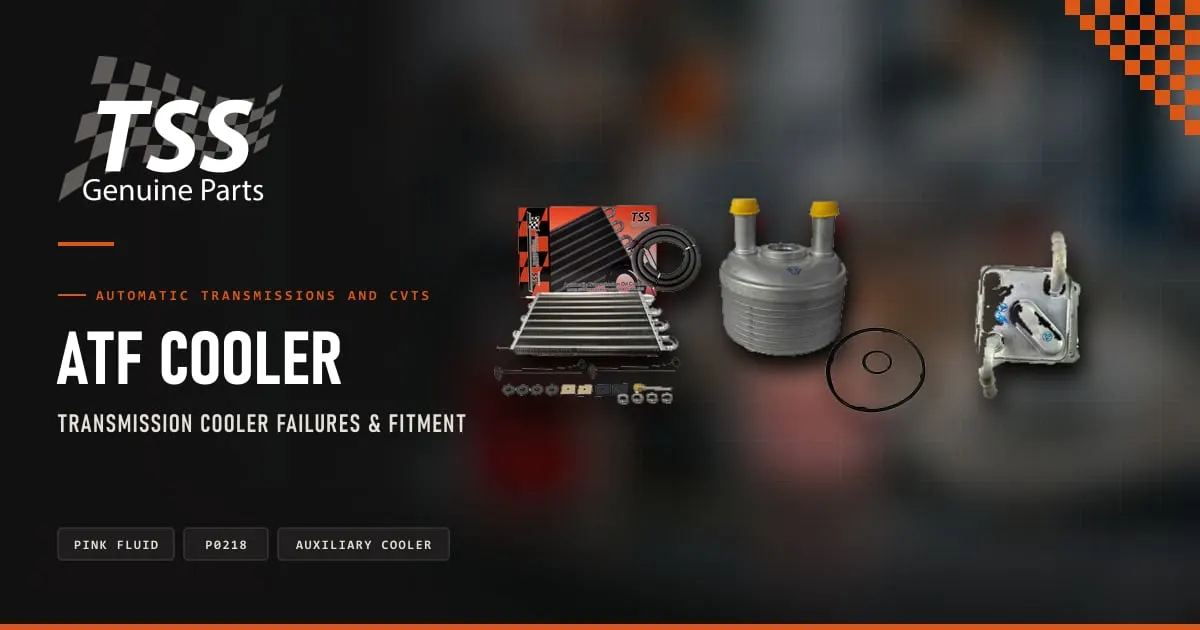
- The cooler removes heat from the transmission fluid, which comes mostly from the torque converter; in many transmissions the fluid returning from the cooler is what lubricates the inside.
- It can sit inside the radiator, bolted to the transmission (with engine coolant) or up front as an auxiliary air cooler.
- Pink, milky or foamy fluid means it mixed with coolant: GM and Ford require rebuilding the transmission and flushing the cooler.
- Per Mazda, a cooler clogged with debris from an earlier failure is the most common cause of a rebuilt transmission failing again.
- Code P0218 means the transmission overheated; P0711 is the temperature sensor, not the cooler.
The transmission cooler rarely gets checked, until the transmission overheats, the fluid comes out pink or a freshly rebuilt transmission fails again. Here's what it does, where it is on each kind of car, how to tell if it's failing or clogged, when it's flushed and when it's replaced, and which TSS cooler your car takes, according to GM, Ford, Nissan, Mazda, Honda and Volkswagen manuals and bulletins.
What does the transmission cooler do?
According to GM service information, the main source of heat in an automatic transmission is the torque converter: hot fluid leaves the converter for the cooler line, is cooled, and returns to the transmission, where it enters the lubrication circuits. That's why a clogged cooler doesn't just heat the transmission: it also starves it of lubrication. GM explains that plugged or restricted coolers and lines cause insufficient lubrication and high temperatures that can lead to premature transmission failure.
Where is the transmission cooler?
It depends on the car. There are three types, and many cars combine two:
| Type | Where it goes and on which cars |
|---|---|
| Inside the radiator | In the side tank of the engine radiator, with two lines coming from the transmission. GM, Mazda's 4- and 5-speed automatics, the 4-speed Versa, March and Tsuru, and several Nissan CVTs use it, for example. |
| Bolted to the transmission | A heat exchanger that engine coolant runs through: it warms the fluid at start-up and cools it on the highway. Volkswagen (01M in the Jetta A4 and 09G), Nissan CVTs (JF011E and JF015E) and Honda use it. Mazda's SKYACTIV also has its cooler mounted on the case. |
| Auxiliary air cooler | A small radiator up front, ahead of the A/C condenser. It comes with towing packages, in Nissan's kit for the Sentra CVT and on the Pathfinder. |
Some transmissions also have a thermal valve that keeps fluid out of the cooler while it's cold: Ford's 6R80 (in the 2009 to 2016 Lobo / F-150) has one inside the case, and GM uses one on the 6L80, the 8L90 and its 10-speeds. That's why thermostats and heat exchangers shouldn't be removed. More on the 6R80 in 6R80 transmission problems.
How do you tell if the transmission cooler is failing?
| Symptom | What it may be and what to check |
|---|---|
| Pink, milky or foamy fluid, like a strawberry milkshake | Coolant mixed with the fluid: a cooler with an internal leak, in the radiator or in the heat exchanger. Check the coolant level too. |
| The coolant reservoir looks pink or overflows, or the engine overheats | Transmission fluid is getting into the coolant through the heat exchanger, as GM documented on 2021 and 2022 US trucks. |
| The transmission overheats: temperature light or message, code P0218 | A clogged cooler or lines, a stuck thermal valve, the wrong fluid level or a slipping converter. |
| Shudder when shifting, slipping or harsh shifts | GM explains that water or coolant changes clutch friction and causes shudder; overheating does too. |
| Leaks at the cooler lines or hoses | Loose fittings, damaged or kinked hoses, or cooler seals: in the US there were several recalls over fire risk. |
| A freshly rebuilt transmission fails again | Debris from the earlier failure trapped in the cooler, restricting flow and lubrication. |
Note: GM says the transmission can overheat and burn its fluid with or without a trouble code, so no code doesn't rule out the cooler.
Pink or milky fluid: when coolant gets in
It's one of the most serious failures. In the US, Nissan extended the radiator warranty on 2005 to 2010 automatic Frontier, Pathfinder and Xterra models because the fluid cooler tube inside the radiator could crack internally and let coolant through; the extension also covers damage to the transmission. GM describes cloudy or strawberry-milkshake fluid, fluid coming out of the vent and milky residue in the pan, and confirms it with a glycol test. The exchanger bolted to the transmission can fail too: GM documented it on its 2021 and 2022 trucks, and Honda on the 2016 and 2017 Pilot 9-speed, both in the US.
A fluid change doesn't fix it. GM and Ford require rebuilding the transmission with all new seals, friction plates and torque converter (Ford also replaces the solenoids and filters), flushing the cooler and its lines, and repairing the cooling system first. How to recognize contaminated fluid is in burnt transmission fluid, metal or water.
Clogged cooler: why a rebuilt transmission fails again
When a transmission fails, metal debris and friction material travel with the fluid and get trapped in the cooler. Mazda puts it this way: the most common cause of repeat transmission failures is a lack of lubrication to the planetary gears, caused by metal particles and debris from an earlier failure building up on the cooler's internal mesh. Ford calls those contaminants a major cause of recurring transmission issues, and Nissan warns they can stay in the radiator, hoses, bypass valve or external cooler and damage the new transmission or valve body.
That's why Mazda, Ford, Nissan, Toyota and Volkswagen require flushing or replacing the cooler when the transmission is repaired or replaced. GM says it doesn't always require it, but recommends it when the transmission overheated or lacked lubrication.
Is the cooler flushed or replaced?
- It's flushed with shop equipment and the correct fluid, never with gasoline, thinner or solvents: Ford prohibits additives and cleaning agents, and Mazda prohibits solvents in the flusher.
- After flushing, the shop measures flow. GM repeats the test and, if flow is still low the second time, replaces the cooler.
- Ford, when no flusher is available, installs a new cooler or an auxiliary one; and if it found sediment in the pan, it installs a new auxiliary cooler.
- Some coolers can hardly be flushed: Volkswagen's bolt-on coolers are very difficult to flush thoroughly because of their internal design, per Sonnax, and coolers with internal fins or mesh trap debris.
- Volkswagen (on one 09G version) and Mazda (on the SKYACTIV) ship a new cooler with the replacement transmission.
- For routine service, GM and Honda don't recommend transmission flush machines, and Mazda doesn't recommend flushing the SKYACTIV as maintenance. veinte07 has a guide to cleaning the cooler before installing a new valve body (in Spanish).
Code P0218 and other temperature codes
| Code | What it means |
|---|---|
| P0218 | The transmission overheated. GM sets it with the fluid at 140 °C (284 °F) for one minute and Mazda (SKYACTIV) at 135 °C for 10 seconds, with a cooler fault among the causes. On Chrysler and Ram, per their service information, it sets above 116 °C (240 °F), and the causes include a restricted cooler or line and the bypass thermostat. |
| P0711 | Not the cooler: GM defines it as a transmission fluid temperature sensor performance fault, when its reading doesn't match the module's temperature. |
If the transmission temperature light comes on, Ram's manual says to stop and let the engine idle or run slightly faster, in P or N, until it goes out.
The Sentra CVT and Nissan's external cooler kit
On the 2007 to 2010 US Sentra with the JF011E CVT, the computer cut vehicle speed to protect the transmission when the fluid got hot on the highway, in hot weather or on long climbs. Nissan's fix included an external cooler kit: an air cooler ahead of the radiator and a 4-port heat exchanger in place of the one on the transmission. Nissan warns that the wrong fluid, overfilling or a coolant concentration over 50% cause the same symptoms. We cover it in Nissan CVT problems and, for Jeep, Dodge and Mitsubishi, in the JF011E CVT.
In Mexico, the only PROFECO alert we found about transmission cooling is from 2021: 23 Infiniti QX60 Hybrid 2019 and 2020 models whose CVT cooling hose could be installed backwards, crack and leak.
How to install an auxiliary cooler
- Cooler makers such as Derale and B&M recommend plumbing it in series after the factory cooler, on the return line to the transmission, and using it alone only when the car has no factory cooler or it can't be repaired.
- It goes where it gets the most air, usually ahead of the condenser, without forcing or damaging its fins.
- Keep the hoses away from sharp edges, moving parts and the exhaust, with no tight bends: a kinked hose restricts flow.
- Don't remove the radiator cooler, the transmission's heat exchanger or the thermostats: the auxiliary cooler adds to the factory system, it doesn't replace it.
- When done, check the fluid level the way the carmaker specifies.
When is it worth it? Mainly for towing or heavy loads. In the US, Honda, for example, ties the 2022 Pilot AWD's maximum towing rating to an accessory transmission cooler. An auxiliary cooler won't fix a transmission that already slips or overheats from an internal failure.
Which TSS cooler does your car take?
These are the TSS transmission coolers and the cars they fit, per our guides to each transmission (01M, 09G, DSG, DP0 and AL4). Always compare the part number or the ports with your cooler before ordering:
| Vehicle | TSS cooler |
|---|---|
| Volkswagen Jetta A4 2.0 and New Beetle 2.0 through 2007 (01M transmission) | 01M cooler, bolted to the transmission; if it leaks at its seals, there's an O-ring kit |
| Volkswagen Bora 2.5, 2011 to 2018 Jetta 2.5, Beetle 2.5 and Passat 2.5 (09G) | 09G cooler. Not for the Virtus, T-Cross, Nivus, Taos or the Jetta from 2019, which use another transmission |
| Volkswagen Polo 1.6 (09G) | Polo 1.6 cooler; compare its part number with the one above |
| VW GTI and GLI, and other VW, SEAT and Audi models with the 6-speed DSG (DQ250) | DQ250 DSG cooler; confirm the part number |
| Nissan Sentra 2007 to 2012, X-Trail 2008 to 2014 and Altima 2.5 2007 to 2012 (JF011E CVT) | original 2-port cooler, or the 4-port one when an external cooler is added, as in Nissan's kit |
| Jeep Compass 2007 to 2013, Patriot 2008 to 2013 and Dodge Caliber 2007 to 2012 (JF011E CVT) | 4-port cooler: per remanufacturers, the transmission in these models comes with the 4-port cooler |
| Mitsubishi Lancer and Outlander with CVT through 2015, and ASX 2013 and 2014 | 4-port cooler for Mitsubishi |
| Nissan Sentra 2013 to 2019 and Note (JF015E CVT) | 2-port cooler. Not for the 2012 to 2019 Mexican Versa, which is a 4-speed automatic |
| Renault Duster, Logan, Sandero, Clio and Megane, Nissan Platina and Peugeot 206, 207 and 307 (DP0 or AL4) | DP0 / AL4 cooler; compare its ports with the original's |
| Any automatic, as an auxiliary cooler | 4-tube, small 6-tube, 6-tube and 8-tube |
TSS coolers
TSS has original-type transmission coolers and universal ones for use as auxiliaries, plus filters, overhaul kits and parts for most automatic transmissions in Mexico. Confirm the model, year and transmission before ordering.
TSS is an aftermarket brand with OEM-comparable quality and quality control on every product. It's sold through our authorized distributors: in Mexico, the full TSS catalog is at Transmisiones Veinte 07, and in the United States at Sun Transmissions.
 Enfriador Universal 8 Tubos TSS para Transmisión Automática
 Enfriador Universal 6 Tubos Transmisión Automática 22000 GVW
 Enfriador Audi Mini Saab Seat Volkswagen Transmision Automatica 09G OEM 09G 409 061
 Enfriador Externo Transmision Automatica Volkswagen 01M OEM 096 409 061 G
 Enfriador De 2 Tubos Para Transmision CVT Tipo Original JF011E RE0F10A
 ENFRIADOR 4 TUBOS PARA CONECTAR ENFRIADOR EXTERNO CVT JF011E RE0F10A
 Enfriador 2 Tubos Tipo Original Cvt Jf015e Re0f11a
 Enfriador Caja Automática TSS 1 Toma Recta y 1 Toma 90 Grado Nissan Renault DPO DP0 AL4