
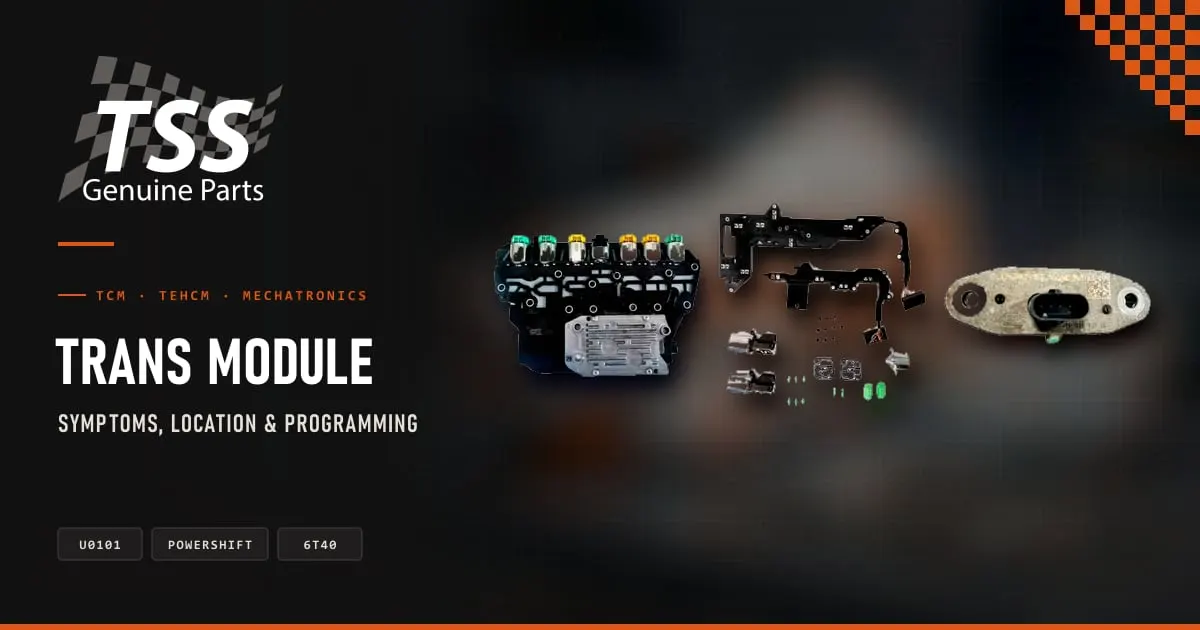
- The transmission control module (TCM) is the computer that decides shifts, pressure and converter lockup, drives the solenoids and puts the transmission in limp mode when it detects a fault.
- Not every car has a separate one: on some it's inside the transmission, on others bolted outside, in a separate box or inside the engine computer.
- Documented module failures: the PowerShift that won't start or loses drive, the 2016 Civic that won't leave P, the 2011 6T40 missing whole gears.
- Many "module failures" are something else: battery, grounds, connectors, software or a mechanical part, and makers say to check those before replacing it.
- A new or used module is programmed to your VIN and then the learning procedures are run; one from another car only works if it's the same part and accepts the programming.
If you're looking for your car's transmission module, first find out where it is: on some cars the transmission computer is a separate box, on others it's inside the engine computer or inside the transmission, on the valve body. Here's what it does, where it sits on the cars most searched in Mexico, the symptoms when it fails, what to check before replacing it and why a new or used module has to be programmed.
What is the transmission module?
It's the computer that decides when to shift, with how much pressure and when to lock the converter: GM explains that it uses the output speed sensor signal to determine line pressure, shift patterns, converter slip and gear ratio. It drives the solenoids (on dual-clutch units, electric motors too), learns as the clutches wear, stores the transmission's codes and, when it detects a fault, puts the transmission in limp mode. Depending on the brand it's called a TCM, TCU, TEHCM (GM) or mechatronic unit (VW, Audi, BMW), or it's inside the PCM, the engine computer.
Where is the transmission module?
There are four layouts, so the answer changes with each car:
| Where it is | Cars |
|---|---|
| Inside the transmission, on the valve body | Cruze, Sonic, Trax, Malibu 2.5, Equinox 2016 on and Captiva Sport (6T40 and 6T45 TEHCM); Silverado and Sierra with the 6L80; Acadia and Enclave (6T75); Mazda 3 from 2014 (SKYACTIV); DSG units; 2014 Grand Cherokee (8HP). |
| Bolted to the outside of the case | PowerShift in the 2012 to 2018 Focus, 2011 to 2019 Fiesta and 2013 to 2017 EcoSport: the module includes the motors that move the shifts. |
| A separate box | Mazda 3 2010 to 2013 (Mazda removes the battery to reach it), Jetta A4 (01M), Bora 2.5 (09G), Equinox 2005 to 2008, Grand Cherokee 3.7, 2015 Chrysler 200 9-speed, Dodge Dart and Allison units. |
| Inside the engine computer (PCM) | Escape and Fusion (6F35), F-150 with the 6R80 from 2011, Mazda 3 through 2009, Chrysler 200 and Avenger 4- and 6-speed, and Grand Cherokee 4.7 and 5.7. |
Watch out for some searches: the 2007 Mazda 3 has no transmission module (the engine computer controls it), the 2018 Beat was only sold as a manual in Mexico, and on the Grand Cherokee the transfer-case module is a different part.
Symptoms of a bad transmission module
These are failures of the module itself that makers document, in US bulletins:
- PowerShift (Focus, Fiesta): intermittent no-start, loss of power or loss of drive; Ford traced it to circuit failures inside the TCM and extended its coverage in the US. In Mexico we found no Ford program or PROFECO alert for that module. More in the PowerShift guide.
- 2016 and 2017 Honda Civic CVT: won't leave P and won't crank, from an internal module fault.
- 2011 6T40: whole gears missing because of a pressure solenoid inside the TEHCM. More in the 6T40 guide.
- 2013 6T75 (Acadia, Enclave): the engine can stall when stopping because the converter solenoid inside the module sticks; GM fixed it with software.
- DSG DQ200: the module inside the transmission can corrode and short out.
In almost every other case, the module puts the transmission in limp mode because it found a fault somewhere else: that's its job, not its failure. The limp gear varies by transmission (2nd on the 41TE, 3rd on the 62TE and 09G, 2nd and reverse on the 6T40), so "it stays in third" doesn't prove it's the module.
In Mexico, FCA recalled 7,067 vehicles, including the 2015 Chrysler 200 9-speed, to replace a transmission harness and update the software, and PROFECO issued an alert for 16,386 Grand Cherokee 2014 and 2015 whose electronic shifter was fixed with reprogramming.
What looks like the module but isn't
Makers warn that many "module failures" are something else:
- The battery: Ford says to resolve any voltage problem before replacing the PowerShift TCM, and on Hyundai code P0880 sets below 7 volts.
- Grounds, connectors and harnesses: on the 6L80, GM found a backed-out terminal in the transmission connector that set communication codes and sometimes prevented cranking; on 2015 and 2016 Silverado and Sierra trucks, the engine belt damaged the module harness.
- Software: FCA fixed several communication codes (U0101, U0402) with an update, without replacing parts.
- The mechanical side: with the 6T40's P0776, GM says to inspect the 3-5-R piston and check line pressure before replacing the module, and with P0880, Hyundai says not to replace the transmission.
- The shift cable: in Mexico, Ford recalled 8,332 Escape and Fusion for the shift cable bushing.
Code U0101 ("lost communication with the transmission module") is often wiring, fuses or grounds, according to GM. And P0700 only says the transmission module stored another code: GM says not to replace the computer for that code.
How do you know if the module is bad?
This is the order makers follow:
- Read the transmission module's own codes, not just the engine's.
- Check the battery and charging system.
- Check fuses, grounds, connectors and harness.
- Ask about software updates for your VIN.
- Rule out the mechanical cause the maker names: piston, line pressure, clutches or sensors.
- Only then, the module: on the PowerShift, Ford replaces it only when the TCM is confirmed as the cause.
Can the module be repaired?
Makers almost always replace the assembly: GM doesn't sell TEHCM parts separately, and Ford replaces the whole PowerShift TCM. Some parts can be repaired: the pressure switches of the 6L80 and 6T70 modules (with new diaphragms), the circuit board of Audi's 0B5 mechatronic unit, or the DQ200 mechatronic unit with repair kits. And often what gets fixed is a connector, a ground or the software.
Does a new module need programming?
Yes, on almost every car:
- GM programs the TEHCM with the VIN and then resets the transmission's learned values; TSS rebuilt TEHCMs are also programmed with the VIN.
- On the PowerShift, Ford copies the old module's data to the new one with its scan tool, reprograms it and runs clutch learning; without that, it warns of erratic shifts.
- Mazda configures the module: since July 2018, SKYACTIV service transmissions ship with it blank.
- Hyundai and Kia load the transmission's barcode values into the module.
- Volkswagen codes the new module like the old one and runs basic settings.
For the first few days shifts can feel firm while the transmission learns, according to Ford and Mazda. What each maker requires after a valve body swap is in the valve body guide.
Does a used module from another car work?
Sometimes. It has to be the same part number and generation (on the 6T40, a 1st generation module won't work in a 2nd or 3rd generation transmission) and accept programming for your VIN. Ford allowed exactly that on the PowerShift: a used, rebuilt or aftermarket module, as long as it accepts Ford's software. Often it doesn't work, because it carries another car's software and learned values, and on BMWs with the EWS4 immobilizer a used transmission or mechatronic unit won't work. Some shops copy the old module's data to the new one, but no maker documents it.
TSS modules and parts
TSS has rebuilt TEHCM modules for the 6T40 and 6T45, and parts for what gets mistaken for the module. For the PowerShift, Mazda, Chrysler, Ford and Volkswagen there's no TSS module:
| Transmission | TSS parts |
|---|---|
| 6T40, 6T45, 6T30 and 6T50 | 1st generation TEHCM (2008 to 2012) and 2nd and 3rd generation TEHCM, programmed with the VIN; 2nd and 3rd generation solenoid screen |
| 6L80, 6L90, 6T70 and 6T75 | diaphragms to repair the module's pressure switches |
| PowerShift | range sensor and actuator motor |
| Audi 0B5 (DL501) | mechatronic circuit boards |
| 01M (Jetta A4) | 10-pin external harness |
| 09G (Bora, Jetta 2.5) | 14-pin external connector |
 Modulo Control Transmision TCM Reconstruido 24268164 14/UP 6T40 6T45 6T30 6T50 con Solenoides Gen2,3
 Modulo Control de Transmisión Reconstruido TCM 24256523 08/12 6T30 6T40 Compatible solo con 1ra Generación con Solenoides Negros
 Diafragmas [5] Plastico Reparacion Modulo 6L45, 6L50, 6L80, 6L90 y 6T70, 6T75 GEN1
 Sensor Switch Rango TRS 6DCT250 DPS6
 Tarjetas para Mecatronica con Sensor Velocidad y 3 Solenoides 0B5 DL501
 Arnés Cable Externo Hembra 10 Pines 095 096 01M 1990-2006
 Conector Externo 14 Pines 09G
 Filtro Solenoides Cuerpo Válvulas 6T40 Gen2/3 Z03