
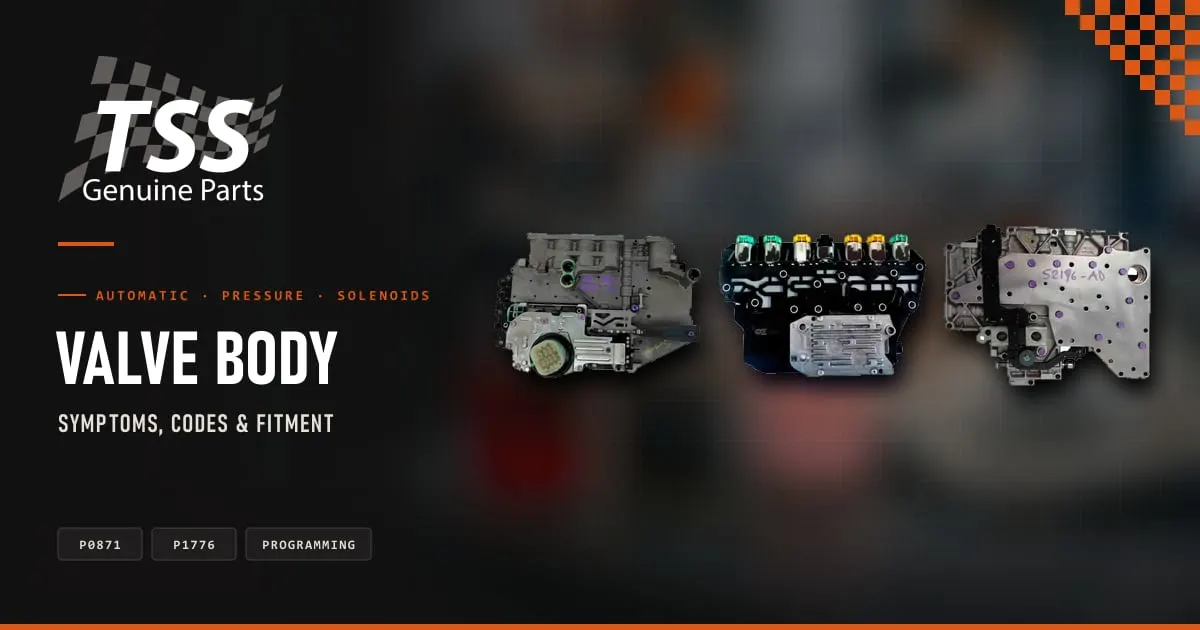
- The valve body is the transmission's hydraulic half: it routes pressurized fluid to the clutches and bands through the manual valve, pressure regulator, shift valves, check balls and separator plate.
- Its documented failures are bore wear (worse when hot), valves stuck by debris, and leaks at the plate, gaskets and check balls.
- It gets confused with the solenoids: on the 41TE, P1776 is a valve in the valve body; on the 62TE, with P076A, Chrysler says to replace only the solenoid pack.
- It can often be repaired, but almost no swap is plug-and-play: Nissan, Ford, GM, Mazda, Toyota and Chrysler require programming or relearning.
- A used one must match in generation, solenoids, check balls and connector, and the cooler has to be flushed or replaced before installing it.
The valve body is the hydraulic half of an automatic transmission: it routes pressurized fluid to the clutches and bands. When it fails, the transmission bangs, slips or goes into limp mode, and it's often confused with the solenoids. Here's what it is, the failures it causes, how it's diagnosed, what has to be programmed after replacing it and which one fits your transmission.
What is the valve body and what does it do?
Volkswagen sums it up: the transmission's clutches and brakes are controlled from the valve body through hydraulic valves, which in turn are moved by the solenoids the computer commands. It holds:
- The manual valve, linked to the lever: it puts the transmission in P, R, N or D.
- The pressure regulator valve, which sets line pressure.
- The shift and clutch valves, which send fluid to each clutch or band.
- The accumulators, which cushion engagements.
- The check balls, the separator plate and its gaskets.
- The solenoids, mounted on it or next to it.
That's why limp mode is the valve body working on its own: with no electronic control, Ford's 6R80 goes to maximum pressure with P, R, N and a single gear (3rd or 5th), and the 45RFE keeps P, R, N, 2nd and 3rd. On some transmissions the computer is mounted on the valve body or is one part with it: the DSG mechatronic unit, the 6T40's TEHCM module, Mazda's SKYACTIV and the 6R80 up to the 2010 model year. And on Nissan CVTs, a new valve body comes with its own calibration data.
Symptoms of a bad valve body
There's no single symptom. The documented ones are bangs into D or R, harsh or late shifts, slipping (especially when hot), neutralizing or missing gears, converter shudder on lockup, and limp mode with pressure or ratio codes. Some examples:
- 4R70W in the F-150: slips between shifts when hot, even after replacing the EPC solenoid, from valve body wear.
- 09G in the Jetta 2.5: wear in the K3 clutch bore gives a bang into reverse, and in the K1 bore, neutral when coasting or a late D.
- Nissan CVT: with code P17F1 it judders; Nissan checks the belt and, if it's fine, replaces only the valve body.
- 45RFE and 545RFE in the Ram and Durango: code P0871 comes almost always from valve body bore wear.
- 6F35 in the 2009 and 2010 Escape and Fusion: with P0735, Ford found a worn regulator bore and replaced the valve body.
Getting worse when hot is a clue: worn bores leak pressure when the fluid is thinner.
Is it the valve body or the solenoids?
A solenoid is an electric valve the computer opens, closes or modulates; the valve body holds the hydraulic valves that signal moves. They give similar symptoms, and makers publish bulletins so shops don't replace the wrong part:
- On Chrysler's 41TE, code P1776 is caused by a valve in the valve body, not the solenoid pack.
- On the 62TE, with code P076A, Chrysler says to replace only the solenoid pack, not the valve body.
- On the 6F35 and 6R80, Ford allows replacing a single solenoid, the harness or the lead frame without replacing the solenoid body.
- On the 6T40, code P0776 points first to the 3-5-R piston, not the valve body or the module.
- On Hyundai and Kia, with P0880, the fuses, ground and harness are checked: "do not replace the transmission".
How solenoids are tested is in our solenoid guide.
How is it diagnosed?
One symptom isn't enough. The shop scans the transmission, checks the fluid level and condition, the connectors and harness, and tests the solenoids against your transmission's values. GM asks for a line pressure check before replacing the module or the valve body, and on Nissan CVTs the belt is checked first. On the bench, a vacuum test measures how much each bore leaks. And if the fluid is burnt or full of debris, or clutches are damaged, replacing only the valve body won't fix it.
Repair or replace?
It can often be repaired. Chrysler says the valve body can be removed without removing the transmission and taken apart to clean and inspect each piece, and Ford notes that not all of them need replacing: bores, springs and valves are inspected. It's replaced as a unit when the wear is severe, when it's integrated with the computer (mechatronic unit, TEHCM) or when the maker requires it.
Does it need programming after replacement?
There's almost always something to do with a scan tool. This is what each maker asks for:
| Transmission | What the maker requires |
|---|---|
| Nissan CVT | Write the new valve body's calibration data to the computer (the CD and QR code must match) and run the learning procedures; otherwise the car may not move. |
| Ford 6R80 and 6F35 | Load the solenoid body strategy code. Ford says not to install a 6R80 valve body that doesn't come with its strategy tag. |
| GM 6T40 | Program the TEHCM module with the VIN and run the learning procedures. |
| Mazda SKYACTIV | Configure the computer, which sits inside the valve body, and run the initial learning. |
| Toyota U660E and U760E | Enter the 60-digit compensation code from the QR label. |
| Chrysler 41TE, 62TE and RFE | Run Quick Learn after replacing or repairing the valve body or the solenoid pack. |
| Volkswagen 09G and GM 4L60E | Clear the adaptations and let the transmission relearn. |
| DSG | Basic settings with a scan tool and a long road test. |
That's why almost no swap is plug-and-play: even on the 4L60E the learned values have to be cleared so the transmission adapts to the new valve body.
Is a used valve body worth it?
Only if it's exactly your version and in good shape, because it can carry the same wear as yours. It must match in generation, number of solenoids, check balls and connector: for example, the 62TE's white or gray connector, the 45RFE's 7 or 5 check balls, or the 6T40's generation 1 versus 2 and 3. And before installing it, the cooler is flushed or replaced: Nissan warns that debris left there can contaminate the new valve body.
TSS valve bodies and parts by transmission
TSS has rebuilt valve bodies for these transmissions. For the 09G, 41TE, 01M and Toyota U660E and U760E there's no TSS valve body, but there are solenoids:
| Transmission | TSS parts |
|---|---|
| 4L60E | Rebuilt valve body 1996 to 1999, 2000 to 2002, 2003 to 2008 without pump sensor, 2006 to 2008 with sensor and 2009 on; 1996 to 2006 plate |
| 4L80E | Rebuilt valve body 1997 to 2003 and 2004 on |
| 4R70W and 4R75W | Rebuilt valve body 2001 to 2008; upper and lower gaskets |
| 4R100 | Rebuilt valve body 1998 on, without solenoid pack |
| 6L80 and 6L90 | Rebuilt 6L80 and 6L90 valve bodies, casting 0955; reuses your TEHCM |
| 65RFE, 66RFE and 68RFE | Rebuilt valve body 2012 to 2018, 5 check balls; for the 45RFE and 545RFE, white-connector solenoid pack |
| 6T40 and 6T45 | Rebuilt TEHCM module 1st generation or 2nd and 3rd: programmed with the VIN |
| DSG 0AM (DQ200) | Mechatronic repair kit and accumulator |
| 09G | No valve body: 3/4" linear solenoids and N88 and N89 solenoids; relearn required |
| 41TE (A604) | No valve body: solenoid pack |
| 01M | No valve body: solenoid kit |
| U660E and U760E | No valve body: solenoid kit |
 Cuerpo de Válvulas Reconstruido 4L60E 4L65E 2003-2008 para Unidades sin Sensor en Bomba
 Cuerpo de Válvulas Reconstruido 4R70W 4R75W 2001-2008
 Cuerpo de Válvulas Reconstruido 6L80 2010-UP Casting 0955
 Modulo Control Transmision TCM Reconstruido 24268164 14/UP 6T40 6T45 6T30 6T50 con Solenoides Gen2,3
 Cuerpo de Válvulas Reconstruido 65RFE 66RFE 68RFE 2012/18 5 Balas
 Cuerpo de Válvulas Reconstruido 4R100 1998-UP Ford
 Kit de Reparación TSS Reforzado Mecatrónica 0AM DSG 7 VW
 JUEGO DE SOLENOIDES LINEALES [6] 3/4 PULGADA DIAMETRO VERIFICAR REQUIEREN REAPRENDIZAJE VW 09G