
- The transmission carries engine power to the wheels, and the gearbox changes the ratio between engine and wheel speed; in Mexico "transmisión" and "caja de velocidades" are used as the same thing.
- Inside: converter, pump, planetary gearsets, clutches, bands, one-way clutches, valve body, solenoids, sensors, computer, bushings, seals, gaskets, filter and parking pawl.
- Outside: pan, dipstick or fill plug, cooler and lines, range sensor, shift cable, mounts, harness and vent; many failures that look like the transmission are here.
- A CVT swaps gears for pulleys and a belt, and a dual-clutch transmission uses two clutches and shift forks instead of a converter.
- When rebuilding a transmission with contaminated fluid, Ford and GM replace all seals, friction material, the converter and filters, and flush the cooler.
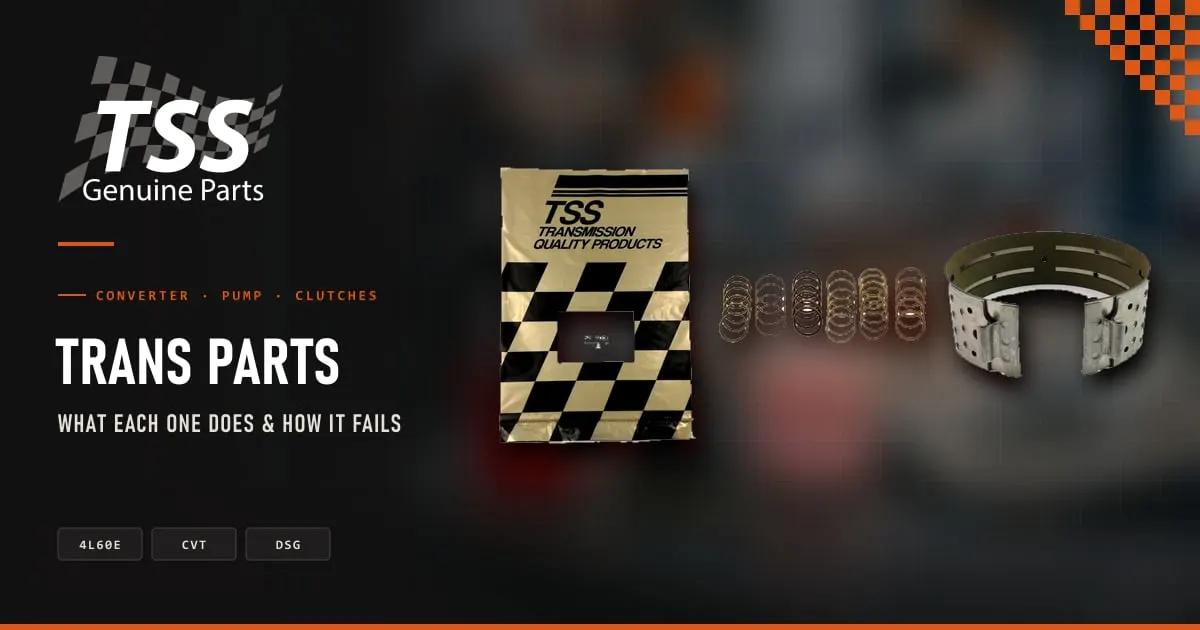
An automatic transmission has dozens of parts, but they fall into a few groups: the converter, the pump, the planetary gearsets, the clutches and bands that control them, the valve body with its solenoids, and the computer. Here's what each part does, the failure it causes when it wears and which TSS part replaces it, with examples from the 4L60E, one of the most searched transmissions.
What is a car's transmission?
Spain's Royal Academy defines it as the set of mechanisms that carry the engine's motion and power to the drive wheels. Its core is the gearbox, which changes the ratio between engine and wheel speed: low ratios to pull away and climb, direct drive (1:1) and overdrive to cruise at lower rpm, plus reverse, neutral and park. In Mexico, "transmisión" and "caja de velocidades" are used as the same thing: Nissan, Chevrolet and Ford manuals say "transmisión", and Ford's index sends "caja de velocidades" to "transmisión". On front-wheel-drive cars the gearbox and differential are one unit: the transaxle.
How does an automatic transmission work?
- Engine power enters through the torque converter, which transmits it through the fluid and multiplies torque at low speed; when it makes sense, its lockup clutch joins engine and transmission without slip.
- The converter hub drives the oil pump, which creates the pressure.
- The planetary gears are always in mesh: each gear comes from driving or holding their members (sun, carrier and ring) with clutches, bands and one-way clutches.
- Those clutches and bands are applied with pressurized fluid routed by the valve body.
- The computer decides each shift from the sensors and drives the solenoids, which open, close or regulate fluid flow.
- If electronic control fails, many transmissions keep a single forward gear plus P, R and N: that's limp mode.
Internal automatic transmission parts
| Part | What it does and the failure it causes |
|---|---|
| Torque converter ("turbina") | Couples the engine to the transmission through the fluid, multiplies torque when pulling away and drives the pump; its lockup clutch joins them without slip on the highway. According to GM, if it fails the car loses power or won't move. Mexican parts stores call the whole converter a "turbina"; technically the turbine is one of its parts. |
| Oil pump | Creates the pressure: the converter hub drives it and it draws fluid through the filter. GM: if it fails, the transmission overheats, loses drive or line pressure goes high or low; its noise rises with rpm. |
| Planetary gearsets | Sun, pinions on their carrier, and ring gear, always in mesh: each ratio comes from driving or holding one of their members. When damaged they whine or grind; Ford documented loss of reverse from a planetary on the 4R75E. |
| Clutches: friction and steel plates, piston, springs and drum | Fluid pushes the piston and squeezes the plates to join two rotating parts. GM: worn plates, a porous piston or a misplaced spring make it slip or lose a gear. |
| Bands and servos | The band wraps around a drum to hold it; the servo is the piston that applies it. GM: a worn 2-4 band prevents the shift on the 4L60E, and a damaged servo seal makes it slip. |
| One-way clutches (sprags and rollers) | Turn freely one way and lock the other, with no fluid pressure. GM: on the 4L60E, if it won't move in D or 3 but does in 2, 1 and R, it's the forward sprag. |
| Accumulators | Absorb pressure as a clutch or band applies to cushion the shift; if they stick, the shift comes harsh or slips (GM). |
| Valve body | Routes pressurized fluid to each clutch and band; worn bores cause bangs and slipping, especially when hot. |
| Solenoids | Electric valves the computer commands to open, close or regulate fluid flow; when they fail, gears go missing or pressure goes to maximum. |
| Sensors (speed, temperature, pressure) | Tell the computer what's happening inside the transmission; when they fail, it shifts harshly or goes into limp mode. |
| Computer (TCM) | Decides the shifts from the sensors and drives the solenoids; on some transmissions it sits inside, on the valve body. |
| Bushings, thrust washers and bearings | Support the shafts and set the end play between parts. GM: bronze slivers in the pan point to worn bushings; a worn pump bushing causes noise and a front leak. |
| Seals, O-rings and sealing rings | Hold each piston's pressure and prevent leaks; GM documents that a cut turbine shaft seal leaves no reverse. |
| Gaskets | Seal the pan, pump and valve body; they come in the gasket kit with the O-rings, lip seals and sealing rings. |
| Filter | Cleans the fluid before the pump; clogged or poorly seated, the transmission is slow to engage and whines. |
| Parking pawl | In P it locks a gear tied to the output shaft so the car can't roll. It doesn't replace the parking brake, and shifting into P while moving damages the transmission. |
External parts
Many failures that look like the transmission are on the outside:
| Part | What it does and the failure it causes |
|---|---|
| Pan and gasket | Holds the fluid, and its magnets catch debris. If the fluid comes out milky or pink, there's water or coolant in it: see burnt fluid, metal or water. |
| Dipstick or fill plug | Used to check the level, which each maker measures differently: with a dipstick (Aveo 2008 to 2018), through a plug with a scan tool (6R80) or only at the dealer. Ford says not to drive with a low level. |
| Cooler and lines | Remove heat from the fluid; when clogged or full of debris, the transmission overheats. |
| Range sensor | Tells the computer the lever position, turns on the reverse lights and only lets the engine start in P or N. |
| Shift cable | Links the lever to the transmission; GM warns that out of adjustment it can make a clutch or band slip or keep it from holding in P. |
| Mounts | Support the engine and transmission; loose or broken, they clunk when shifting into D or R. More in transmission noise. |
| Harness and connectors | Carry the sensor and solenoid signals; water or corrosion in the connector sets codes that look like a transmission failure. |
| Vent | Lets the transmission breathe; fluid coming out of it can mean overfilling, a damaged pump or water in the fluid. |
Parts of a CVT
A CVT has no fixed gears: Nissan explains that it adjusts the width of two pulleys and changes the radius of the steel belt running between them. Besides the pulleys and push belt (a chain on some), it has a converter with lockup, a pump, a planetary set with a forward clutch and reverse brake, a park gear, a valve body (with a step motor on the JF011E), speed and pressure sensors and its computer. CVT fluid is part of the design: the Mexican Jeep Compass manual warns that another fluid can make the belt slip. More in the Nissan CVT guide.
Parts of a dual-clutch transmission
The DSG and PowerShift have no converter: two clutches split the gears (on the DQ250, clutch 1 carries 1st, 3rd, 5th and reverse, and clutch 2 the even gears) and shift forks with synchronizers select the gears, like a manual. Volkswagen uses wet clutches on the DQ250 and dry ones on the DQ200; Ford's PowerShift is dry. The mechatronic unit (or the PowerShift module) combines the computer with the actuators.
What gets replaced in a transmission repair?
With contaminated fluid, Ford's 6R80 manual calls for a full teardown replacing all seals, all friction material, the converter, the parts with bonded seals, the solenoids and the filters, and flushing the cooler and lines; GM asks for almost the same. Everything else is replaced only if worn: Ford notes that not every valve body needs replacing, and bushings, drums and planetaries are inspected. Then come the relearns or programming. The repair parts come in the gasket kit (gaskets, O-rings, lip seals and sealing rings) and in the friction packs.
TSS parts by component
| Part | TSS parts |
|---|---|
| Gasket kit | Red and Gold; for example, Gold 4L60E 2004 on |
| Friction and steel plates | Friction plates and steels; for example, 09G friction pack |
| Bands and servos | Bands and pistons; for example, A4LD and 5R55E intermediate band |
| Solenoids | Solenoids; for example, 4L60E A and B solenoid kit |
| Sensors | Sensors and range switches; for example, 6T40 input sensor |
| Pump and bushings | Pump parts and bushings; for example, 4R70W and C6 pump bushing |
| Torque converters | Converters; for example, 4.0 L for the 5R55E, low stall |
| Filters | Filters; for example, JF414E (Versa and March) |
| Valve bodies and modules | Valve bodies and modules |
| Seals and washers | Seals and thrust washers |
 FILTRO JF414E
 Juego de Empaques TSS H-D 2004/UP 4L60E 4L65E 4L70E
 Pack Discos de Pasta TSS 09G 09M TF-60SN TF-61SN 2007/UP con Discos K2 de 55 y 60 Dientes
 Banda Flexible Intermedia Overdrive C3 A4LD 4R44E 5R55E
 KIT SOLENOIDE DE CAMBIOS A-B 4L60E
 Sensor Entrada Velocidad 2 Cables Conector Hembra 2 Pin 2008/UP 6T40
 BUJE DE BOMBA FORD C6 FMX 4R70W AODE
 Convertidor 11" 16 Puntos Stall Bajo 4.0 L 4R44E 4R55E 5R55E