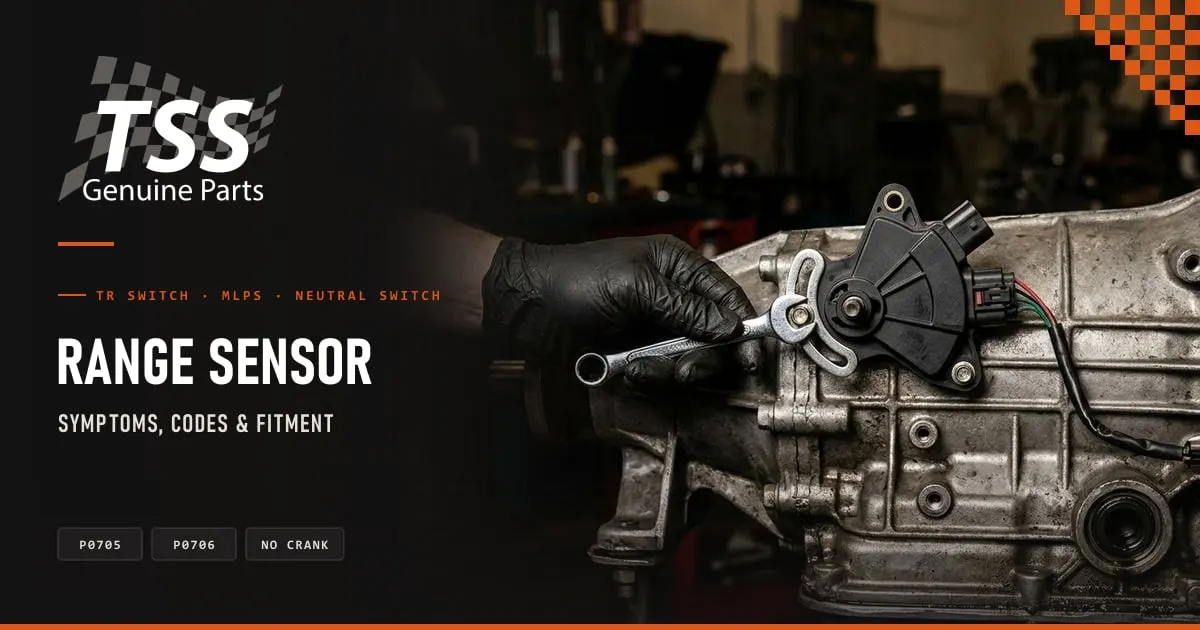

- P0705 means the computer can't make sense of the range sensor signal, almost always because it sees two positions at once or none. P0707 is signal low and P0708 signal high, but each make defines them differently.
- Symptoms: no crank in P or N, the dash doesn't show the position, it stays in one gear, harsh engagement and reverse light problems.
- The most common causes are a misadjusted cable, water or corrosion in the connector, a chafed wire and a fuse; the sensor comes after, and the computer last.
- Diagnosis goes in this order: scan tool against the lever, adjustment, connector, fuses and feed, multimeter test of the sensor, wiring and, last, software and computer.
- Don't drive it as if nothing were wrong: it can stay in one gear, not restart or, on some models, shift to neutral.
Codes P0705, P0707 and P0708 point to the range sensor circuit, the part that tells the computer which position the lever is in (P, R, N, D). They don't mean the sensor has to be replaced: here we explain what they mean on each make and how to diagnose them step by step, with the test values the makers publish. What the sensor is and where it sits are in our transmission range sensor guide.
What do P0705, P0707 and P0708 mean?
In general, P0705 is a range sensor "A" circuit fault (PRNDL input), P0707 is signal low and P0708 is signal high. But each maker sets its own conditions, and not all use all three:
| Make | How it defines them |
|---|---|
| Toyota | P0705: two or more positions on at the same time, or none. Toyota calls it the park/neutral position switch, and the test only runs with the battery above 10.5 V |
| Nissan (Versa, Sentra, March CVT) | P0705: two or more positions on for 5 seconds (a short). P0706: no position for 30 seconds (an open circuit or a misadjusted cable) |
| Honda | P0705: short in the range switch circuit (several positions at once). Honda says a mechanical transmission problem doesn't cause it. It also uses P1705 and P1706 |
| Mazda | P0705: two or more positions for 12 seconds or more |
| Hyundai and Kia | P0705: circuit fault; P0706: signal out of range; P0707: open circuit; P0708: short or several positions at once. They call it the inhibitor switch |
| Ford (digital sensor on the 6R80, 5R55, 4F27E) | P0705: the signal matches no position; P0707: signal low; P0708: signal high; P0709: intermittent signal between two positions |
| GM | Cars with Aisin or Daewoo transmissions, like the Spark, use P0705. The 4L60E and its successors use their own codes: P1825, P1915 and P182E |
| Chrysler, Dodge and Jeep | P0705 to P0708 on the range sensor; on the 2023 Compass, for example, a chafed harness set P0707 and limp mode |
| Volkswagen (01M, 09G) | Shown as 17089 and 17090 (equivalent to P0705 and P0706) on the F125 multifunction switch |
P0706 is the same sensor with an out-of-range signal; we cover it in the range sensor guide. And on Nissans with a manual transmission, the neutral switch code is a different one: P0850.
P0705, P0707 and P0708 symptoms
- It won't crank in P or N, or cranks only sometimes (Ford, Hyundai and Kia list it).
- The dash doesn't show the lever position or shows the wrong one, and the check engine light comes on.
- Limp mode: it stays in one gear (4th on Hyundai and Kia 6-speeds; 3rd or 5th on Ford's 6R80).
- Harsh engagement into D or R, because the computer raises line pressure to the maximum to protect itself.
- The reverse lights don't come on, or come on outside R, because the same sensor controls them.
What causes these codes?
In order, according to the makers' manuals and bulletins:
- A misadjusted shift cable or sensor, especially after the transmission is removed, the engine is replaced or the lever is disconnected. On contact-type switches (Nissan, Toyota, Hyundai, Kia, Honda) bad adjustment can set the code; on Ford's digital sensor, according to Ford, it can't.
- Water, corrosion or a bad ground at the connector or harness. Nissan found that on the 2012 to 2014 US Versa, water coming in through the tail lamps set P0705, and said not to replace the CVT for it; Hyundai checks the tail lamp ground.
- A chafed wire shorting to ground or to power.
- A blown fuse or no feed at the sensor.
- A failed or worn sensor.
- On transmissions with the sensor inside (Ford's 6R80, GM's IMS, several CVTs), the link to the manual valve or metal debris.
- The computer or its software, always last. And low battery voltage, or a badly installed alarm or remote starter.
Step-by-step diagnosis
This is the order Toyota, Nissan, Honda, Mazda, Hyundai and Ford manuals follow. You need a scan tool that reads transmission data and a multimeter:
- Step 1. Read all codes and the freeze frame data. If there are voltage or communication codes (U0100, U0101, P0882), deal with those first, and measure the battery: below 12 V, charge it before going on.
- Step 2. Engine off and brake pressed, put the scan tool on the range sensor data and move the lever through every position. The position the computer sees must match the lever in each one, and two should never be on at once.
- Step 3. Check that it cranks only in P and N, that the reverse lights come on only in R and that the dash reads correctly.
- Step 4. Check the cable and sensor adjustment with the lever in N (except on Ford's digital sensor). It's the number one cause after transmission work.
- Step 5. Unplug and inspect the connector: bent or pushed-out pins, a missing seal, water or green corrosion. With the scan tool connected, wiggle the harness and watch whether the reading jumps.
- Step 6. Check the transmission fuses and measure the feed at the sensor connector with the key ON.
- Step 7. Test the sensor on its own, unplugged, with a multimeter position by position (continuity or resistance, per the maker).
- Step 8. Check the wires between the sensor and the computer: voltage in each position, short to ground and short to power.
- Step 9. Only on transmissions with the sensor inside: drop the pan and check the sensor's link to the manual valve and look for debris.
- Step 10. If everything passes and the code comes back: software update and, last, the computer. After any repair, clear the codes, repeat the maker's test and check cranking, reverse and the dash.
What your results mean
| What you find | What it means and what to do |
|---|---|
| The scan tool matches the lever in every position and the code doesn't come back | Intermittent fault: do the wiggle test, check connectors, water and grounds, and test under the maker's conditions |
| The dash or scan tool shows another position (for example, N with the lever in D) | Misadjusted cable or sensor: adjust it in N with the maker's gauge or pin and check again |
| Two positions on at once (for example, P and R) | Short between circuits or a failed sensor: test the sensor position by position and look for wires touching or water |
| No position on at all (blank display) | Open circuit, blown fuse, no feed or a badly misadjusted cable: check fuse, feed, ground and connector before the sensor |
| No feed reaches the sensor | Open feed or fuse: repair it before touching the sensor |
| The sensor fails the multimeter test | Failed sensor: replace it, adjust it as the maker says, clear codes and verify |
| The signal is shorted to ground or to power | Chafed wire or damaged harness: repair the harness and find where it rubs |
| Everything passes but the code comes back | Computer or software: update first, then the computer, only after a complete diagnosis |
Makers' test values
These values come from each make's manuals, for the transmissions listed. For other models, use the table in their manual:
| Maker | What's measured and the expected value |
|---|---|
| Toyota (A750F, U140F) | Sensor unplugged: under 1 Ω in its position and 10 kΩ or more in the others. At the harness: 10 to 14 V in the active position and under 1 V in the others. On the A750F, the P and N signal is inverted: under 2 V in P or N (A750 guide) |
| Ford 6R80 (digital sensor) | 100 to 150 Hz signal with a different duty cycle in each position (in P, 18.1 to 25.8%); feed above 9.5 V, signal above 4.8 V and more than 10 kΩ to ground |
| Hyundai and Kia (6-speed) | Voltage drop on the tail lamp ground under 0.2 V; the inhibitor switch is aligned with a 5 mm pin in N |
| Nissan (Versa CVT) | Switch continuity test per position with the manual's table; Nissan aligns the Versa switch in N with a special tool and torques it to 5.6 N·m |
Can I drive with code P0705?
No maker says it's safe. The transmission goes into protection mode: it stays in one gear, engages harshly, may not restart after you switch it off and, on some models, can shift to neutral (Chrysler ran a US recall for a range sensor harness on 9-speed transmissions). If the car moves normally, take it carefully to the shop; if the lever doesn't match the dash or it won't crank in P or N, don't drive it. More on limp mode in why won't my automatic transmission shift?.
P0705 myths
- "It's low or dirty fluid, or the valve body": no. Honda says a mechanical fault doesn't cause it, and Toyota and Nissan list only the sensor, harness and computer. The exception is transmissions with the sensor inside.
- "It's almost always the sensor": no. Isuzu found many replaced sensors that were fine, and Nissan traced Versa P0705 to water in the tail lamps.
- "P0707 and P0708 mean the same on every car": no. On Hyundai, P0707 is an open circuit and P0708 a short; on Ford, signal low and high.
- "Replace the computer": every procedure we reviewed leaves it for last.
- "These codes don't turn on the check engine light": they do, according to Toyota, Ford and Hyundai.
- "A new sensor doesn't need adjusting": nearly all are aligned in N, and some transmissions, like the PowerShift, need a relearn with a scan tool.
After the repair
A new sensor is almost always aligned with the lever in N, using the gauge or pin the maker specifies. Some transmissions, like Ford's PowerShift, also need a relearn with a scan tool, and a replacement computer must be programmed (we explain it in the TCM transmission module guide). Finally, clear the codes, repeat the maker's test in each position and check that it cranks only in P and N, that the reverse lights work and that the dash reads correctly. If communication codes also show up, see the U0101 code guide.
See TSS range sensors and switches
TSS range sensors
The TSS catalog has range sensors for these transmissions:
| Vehicles and transmission | TSS sensor |
|---|---|
| Nissan Sentra and X-Trail (RE0F10A CVT) | TR switch with 90° connector |
| Dodge Journey and Caliber, Jeep Compass and Patriot, Mitsubishi (JF011E CVT) | park/neutral switch with straight connector |
| Ford Focus and Mazda 3 (4F27E) | 9-pin TR switch |
| Chrysler and Dodge (A604 / 41TE, 1998 on) | flat-pin TR switch |
| Chevrolet Optra (ZF 4HP16) | lever position switch |
| U440E and U441E transmissions | TR switch |
| Renault and Peugeot (DP0 / AL4) | TR switch |
| Ford PowerShift (DPS6) | rebuilt TRS range sensor |
The connector and pin count change by year: confirm your transmission in the Transmisiones Veinte 07 transmission finder before ordering.
 Switch TR MLPS Conector 90° Nissan JF011E RE0F10A
 Switch Parking Neutral Conector Recto Dodge Jeep Mitsubishi JF011E RE0F10A
 Switch TR 9 Pines Ford Mazda Transmision Automatica 4F27E OEM 5S4Z-7F293-AA
 Switch Tr Posicion De Palanca Mlps Pines Planos 1998/UP A604
 SWITCH POSICION PALANCA OPTRA ZF4HP16
 Switch Tr Posicion De Palanca U441E U440E
 Switch TR DPO AL4 OEM 252410 Renault Peugeot
 Sensor Switch Rango TRS 6DCT250 DPS6 Reconstruido